|
|
    
|
Soyuz-2/Fregat flies its first mission from Baikonur On Oct. 19, 2006, Russian and European teams launched the first Soyuz-2 rocket from Baikonur equipped with a Fregat upper stage after grueling multi-month campaign, which involved five failed attempts to fire the rocket.
Second flight: Soyuz-2-1a/Fregat During 2006, European Space Agency, ESA, planned to launch a sophisticated meteorological and environmental research satellite on the Russian rocket into a high-inclination orbit from Baikonur Cosmodrome in Kazakhstan. It was supposed to be the second mission of the Soyuz-2-1a rocket, but, at the same time, the first launch of the new rocket from Baikonur. In addition, for the first time, the Soyuz-2 would be equipped with an enlarged payload fairing and the Fregat upper stage. Originally, there were reports that the second mission of the Soyuz-2-1a rocket (this time equipped with the Fregat upper stage) would carry another dummy payload, from Plesetsk. As of beginning of 2006, this flight was expected in the third quarter of the same year, however it was superceded in the flight manifest by the mission to deliver the Metop satellite from Baikonur. The large size and the weight of Metop required the use of a large payload fairing, developed for the Soyuz-ST rocket, designed for commercial missions from Kourou, French Guiana. Also, the installation of the propulsion system on the third stage had to be modified to compensate for unusual center of gravity of the payload. Flight plan The vehicle was to follow an unusual trajectory extending northwest, while absolute majority of missions from Baikonur head east and northeast. This flight path would inject the satellite into the so-called sun-synchronous polar orbit with the altitude of 820 kilometers and inclination 98.72 degrees toward the Equator some 68 minutes after the launch. Extending from the North Pole to the South Pole, such orbit would enable the Metop to observe practically any location on the Earth surface during morning hours local time. Soyuz-2-1a/Metop launch sequence:
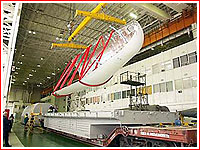
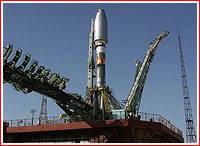
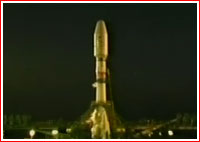
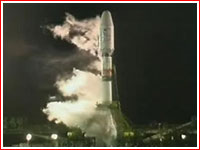
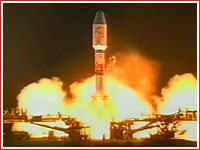
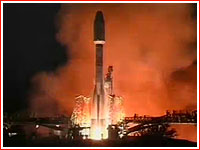
The pre-launch processing In January 2006, officials in Baikonur confirmed that the Soyuz-2-1a rocket would carry ESA'a Metop. At the time, the work was taking place to prepare processing facilities at Site 31 for the Soyuz-2-1a rocket, while the launch was scheduled for June 30, 2006. On January 30, a Soyuz-2-1a rocket, fit with the ST-type fairing for the first time, was rolled out to the launch pad at Site 31 for a series of tests. The integration of the 4,193-kilogram Metop spacecraft and its Fregat upper stage started in Baikonur on July 5, 2006, in the clean room at Site 112. At the time, the launch was set for July 17, 2006. The flight-ready rocket was rolled out to the launch pad at Site 31 on July 14, 2006, at 06:35 Moscow Time. The vehicle was installed on the pad at 08:45. July 17: First launch attempt On July 17, 2006, the launch of the Soyuz-2-1a rocket was scheduled at 20:28:10 Moscow Summer Time (16:28 UTC). However 1 hour 36 minutes before scheduled liftoff, the flight control system of the Soyuz-2 interrupted launch sequence upon detecting an error in setting up the vehicle's navigation. During the night, the problem was identified and reproduced on a dedicated test stand at NPO Avtomatika in Ekaterinburg, the developer of the flight control system, and necessary corrections were made in the rocket's avionics, Roskosmos said. July 18: Second launch attempt The new attempt was made on a backup date of July 18, however this time, the flight control system detected an anomaly in the pneumatic hardware of the rocket, soon after the process of refilling of the vehicle's propellant tanks had started. As a result, the State Commission overseeing the launch made a decision to drain the propellant from the vehicle and analyze the possibility of another launch attempt on July 19, 2006. July 19: Third launch attempt A third attempt to launch the Soyuz 2-1a rocket with the Metop satellite on July 19, 2006 was aborted 2 minutes 19 seconds before a scheduled liftoff, according to the Russian sources (three minutes, five seconds before launch, according to Eumetsat.) First delay On July 20, 2026, Igor Panarin, an official representative of the Russian space agency, Roskosmos, told Interfax news agency that the Metop launch would be delayed by no less than two months. According to Panarin, errors in the mathematical processing of the launch were discovered. According to Eumetsat, the problem was in the ground support system. Apparently, the command for the purging of the launch vehicle's turbo pumps was not received by the rocket, triggering automatic abort. On July 21, the Soyuz-2-1a was removed from the launch pad and returned to the processing building at Site 31. The payload section along with the third stage was to be separated from the rest of the launch vehicle and then from the third stage as well, in order to be transported to Site 112 for storage. In the meantime, there were reports that three booster stages of the Soyuz-2-1a rocket would be shipped back to its manufacturer TsSKB Progress in Samara for inspections and cleaning required after removing of the rocket from the launch pad. Second round On Aug. 7, 2006, ESA announced that during the previous week, meetings between ESA, EUMETSAT, CNES, NOAA and Starsem set the new launch attempt for the Metop satellite for Oct. 7, 2006. The processing work was jump-started in Baikonur on Aug. 31, 2006. NPO Lavochkin's personnel detached Fregat upper stage from the satellite transferred it to the Hall I of the assembly building at Site 112 to remove its thermal protective layers in order to re-test onboard avionics. Sometimes at the end of September or beginning of October 2006, ESA made a request to postpone the launch from October 7, 2006, to October 10 or 11 and then to the 12th of October, for extra checks of the spacecraft. October 17: Fourth launch attempt On Oct. 17, 2006, the launch of the Soyuz-2-1a rocket from Baikonur's Site 31 was scrubbed once again due to a technical glitch only two minutes before a scheduled liftoff at 20:28 Moscow Time. However the same night, a new launch attempt was set for a backup date of Oct. 18, 2006, at 20:28:13 Moscow Time. As it transpired later, on October 17, the launch countdown was stopped by a control system, after it failed to confirm the pressurization of the oxygen tank aboard the 3rd stage of the launch vehicle, according to the official statement by Roskosmos released a day later. The pressurization of the oxygen tank was scheduled to take place at 2 minutes 30 seconds before the liftoff, however despite the launch operations were discontinued at that point, the countdown clock at the flight control center went on until 20 seconds before launch, resulting in erroneous reports about the scrub at T-20 seconds. After an analysis of the situation and additional checks, the launch personnel fixed the problem, Roskosmos said. October 18: Fifth launch attempt Another launch attempt took place on Oct. 18, 2006, or 24 hours after it was scrubbed for the fifth time. However, yet again, the launch operations had to be stopped due to bad weather, according to Starsem. The payload operator Eumetsat announced that likely presence of strong winds at high altitude led to the decision to cancel the preparations on October 18. October 19: Launch The Soyuz-2-1a rocket, carrying Europe's MetOp meteorological satellite finally lifted off on Oct. 19, 2006, at 20:28 Moscow Time, (16:28 GMT, 12:28 p.m. EDT). Minutes after the launch, European space officials confirmed the nominal cutoff of the third stage and the separation of the payload section, known by Russian abbreviation as KGCh. At 22:17 Moscow Time (18:17 GMT, 2:17 p.m. EDT) Jean-Yves Le Gall, Chairman and CEO of Starsem, a Russian-European joint venture, which marketed the Soyuz family of rockets, declared the launch a success.
|
|

|