|
|
Origin of the Vostok spacecraft Within Sergei Korolev's OKB-1 design bureau, founded in 1946 exclusively as a missile development organization, all work on spacecraft was originally concentrated at Department 9 lead by Mikhail Tikhonravov. Tikhonravov's team would be instrumental in the development and launch of the world's first artificial satellite.
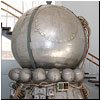
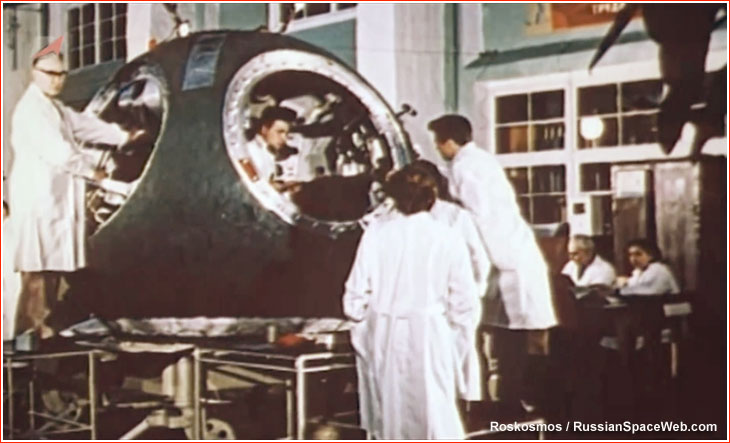
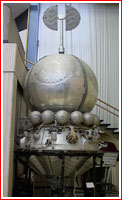
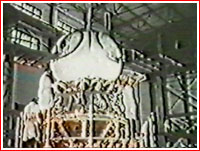
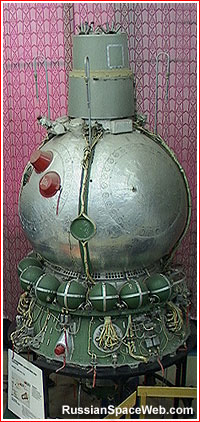
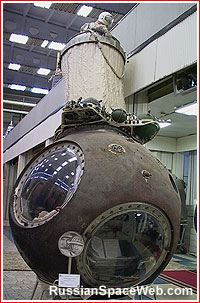
Descent module of the Vostok spacecraft during assembly in Podlipki. Origin of the Vostok spacecraft Active development of ballistic missiles in the USSR in the second half of the 1940s gave new impetus to the idea of rocket-propelled space flight first advanced by Tsiolkovsky, Goddard, Oberth and others earlier in the 20th century. After World War II, the German A-4 (V-2) rocket became a basis for the new effort to conquer space in the US and the USSR. One of the earliest Soviet concepts of sending a pilot into the stratosphere on the A-4-based rocket was concieved by Mikhail Tikhonravov from a top-secret NII-4 research institute tasked to support the Soviet missile development program. A veteran of the early Soviet rocket development effort in the 1930s, Tikhonravov proposed the VR-190 rocket designed to carry a single pilot on a suborbital trajectory. Although VR-190 had never been built, a similar study was later initiated at the OKB-1 design bureau led by Sergei Korolev and responsible for the development and testing of the Soviet long-range ballistic missiles. Within the 9th department at OKB-1, a group led by Nikolai Belousov studied the possibility of launching a piloted rocket on a ballistic arc as high as 100 or 200 kilometers. Belousov's team could take advantage of much more advanced and powerful rockets, which were under development during the 1950s, such as R-3 or R-5. Engineers also made comparison between a vehicle which would "hop" into space on a ballistic trajectory and a true orbiting spacecraft. The suborbital flight, while requiring most attributes of a real space mission, would provide only 2-4 minutes of weightlessness in a 10-15-minute trip. However even a single-orbit flight would enable the pilot to be weightless for an hour and a half, making the scientific value of the mission much higher. Although suborbital vehicles could be launched on smaller rockets, they were eventually ruled out in favor of a true orbital spacecraft. However as late as 1956, the orbital flight was apparently still considered in parallel with possible piloted launches of ballistic (suborbital) rockets. (84) Design of the Vostok spacecraft
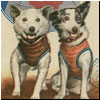
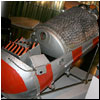
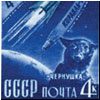
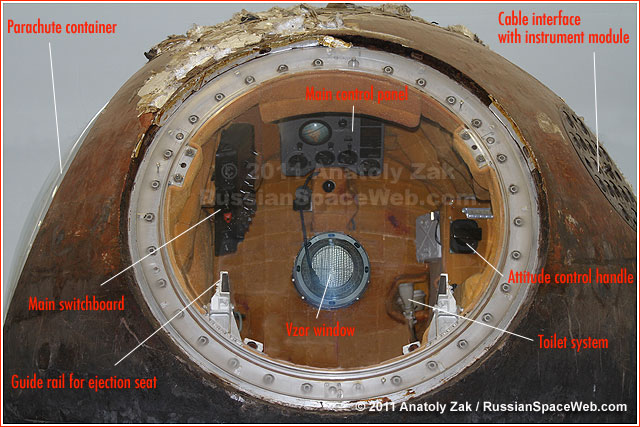
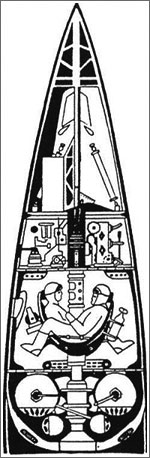
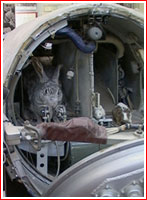
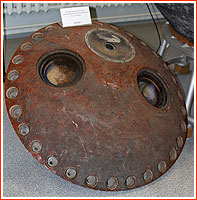
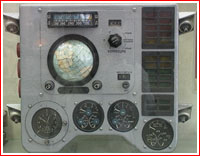
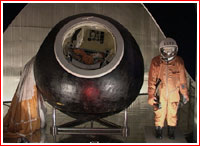
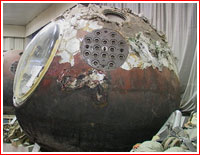
Gagarin's descent module and key features of its interior, minus the ejection seat, as seen via the ejection hatch. Severe damage to the thermal protection layer visible at the top of the capsule was likely caused by the wind drag after the touchdown and before the parachute could deflate, not by the heat during the reentry. The preliminary design for the future manned spacecraft was officially concluded on May 15, 1958, favoring an orbital vehicle. A three-stage rocket for unmanned lunar missions would be re-purposed for manned missions in Earth's orbit. The lifting capabilities of the rocket allowed it to carry an almost five-ton spacecraft into low Earth orbit. The final design of the Vostok spacecraft consisted of two main components: a descent module with the pilot cabin and the instrument module equipped with a braking engine. As a purely experimental vehicle, Vostok had to safely carry a pilot in orbit and return him/her to Earth. The main flight control function was limited to orienting the spacecraft tail first for the firing of the braking engine prior to reentry into the atmosphere. The braking engine had to slow down the spacecraft by around 140 meters per second to ensure the safe return of the vehicle. Firing of the engine would be commanded by a programming timer (84), later known as PVU Granit. Since the successful completion of the reentry maneuver meant life or death for the pilot and the braking engine could not be backed up by any other hardware, engineers decided to launch Vostok missions into a 180 by 235-kilometers orbit. At that altitude, the density of the upper atmosphere would be enough to slow down and send the spacecraft back to Earth roughly five days after launch, with a margin of error of 2.5 days. Vostok would have enough food, water, air and power onboard to support a 10-day mission. Proposed Vostok modifications Along with the development of a regular version of the Vostok spacecraft, OKB-1 and its contractors studied alternative designs, particularly a descent module powered by a helicopter-like rotor. This design was particularly favored by Korolev. The key goal of the project was to have a complete control of the landing trajectory, ending dependency on winds during a parachute descent. The idea was never implemented. Upon the conclusion of six manned flights of Vostok in 1963, new missions were under consideration. Orbital flights carrying animals to an altitude of 1,000-1,200 kilometers and lasting up to 10 days were planned, apparently to study the effects of radiation beyond low orbits shielded from space rays by the magnetic field of the Earth. There were also plans to equip the Vostok spacecraft with an additional solid-propellant motor which could serve as a backup for the main braking engine. This improvement would eliminate the self-imposed limit for an orbital altitude of Vostok missions in order to enable natural reentry of the spacecraft following main engine failure. To ensure safe touchdown of the pilot inside Vostok instead of ejection in mid air, developers proposed to install a special landing engine on the descent capsule. The device would reduce the impact speed from 10 to 2 meters per second. Vostok's ejection seat was still expected to stay onboard as an emergency feature. (84) Soft-landing engines did find their way into the design of the Voskhod spacecraft, however, their passengers would not have ejection seats due to mass limitations of the multi-seat incarnation of the spacecraft. Vostok's dog missions In preparation for the first manned orbital mission, four 1K prototypes of the Vostok spacecraft carried pairs of dogs each in 1960. Two of these missions failed killing four dogs. In March 1961, a pair of unmanned versions of the Vostok spacecraft designated 3KA carried a single dog each during final dress rehearsals of Gagarin's upcoming flight. Both returned their passengers safely to Earth, clearing the way for the historic launch.
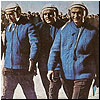
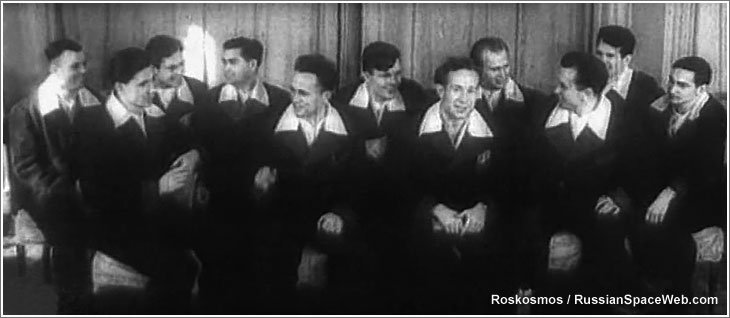
Cosmonaut candidates apparently filmed during medical tests in the fall of 1959. Left to right: Gagarin, Nelyubov, Titov, Nikolaev, Gorbatko, Khrunov, Leonov, Anikeev, Popovich, Shonin, Bykovsky. On March 7, 1960, 12 pilots were officially enrolled into cosmonaut training and they were soon joined by eight others. The group included Ivan Anikeev, Pavel Belyaev, Valentin Bondarenko, Valery Bykovsky, Valentin Varlamov, Boris Volynov, Yuri Gagarin, Viktor Gorbatko, Dmitry Zaikin, Anatoly Kartashov, Vladimir Komarov, Aleksei Leonov, Grigory Nelyubov, Andriyan Nikolaev, Pavel Popovich, Mars Rafikov, Gherman Titov, Valentin Filatiev, Yevgeny Khrunov and Georgy Shonin. In the summer of the same year, six pilots were selected among 20 trainees for in-depth preparations for upcoming Vostok missions. That group included Valery Bykovsky, Yuri Gagarin, Grigory Nelyubov, Andriyan Nikolaev, Pavel Popovich and Gherman Titov. Order No 176 of the Soviet Air Force commander formally endorsed this "group within a group" on October 11, 1960.
An overview of the early Russian manned space flight projects:
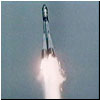
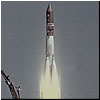
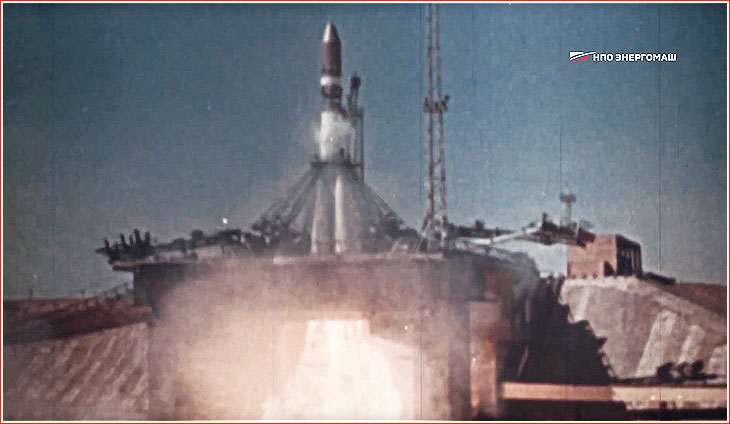
A frame from footage often attributed to the launch of the Vostok spacecraft with Yury Gagarin on April 12, 1961.
Missions within Vostok and Voskhod projects:
Vostok project development milestones: 1959 Jan. 5: Soviet government (TsK KPSS and Soviet of Ministers) decree on the selection of first cosmonauts. 1959 May 22: Soviet government (TsK KPSS and Soviet of Ministers) decree on the selection of first cosmonauts. 1960 end of April: First prototype of the Vostok spacecraft arrives at the Tyuratam test site. (100)
|
|

|