|
US-A and US-P military satellites
By 1957,
Nikita Khrushchev had finally won struggle for power in the post-Stalinist
Soviet Union. Among many sweeping changes the new leader started in the
USSR was the modernization of the Soviet Navy. (109)
Khrushchev scrapped the construction of grandiose battleships
ordered by Joseph Stalin, opting instead for smaller maneuverable Navy
armed with cruise missiles. (87)
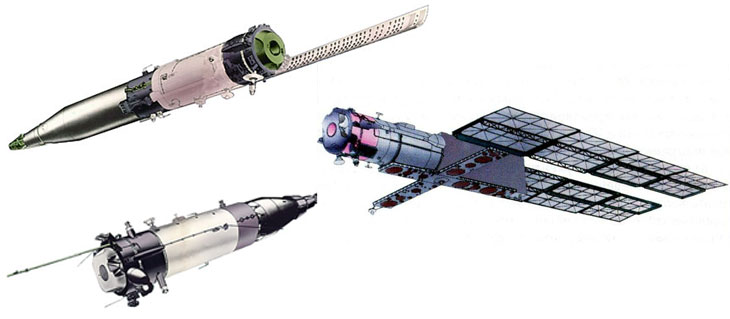
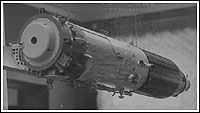
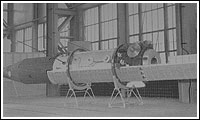
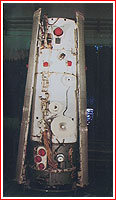
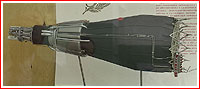
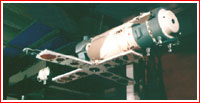
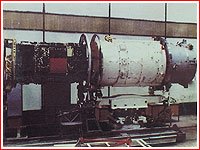
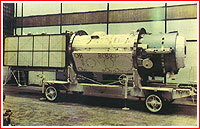
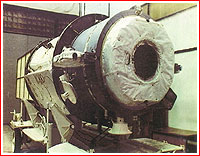
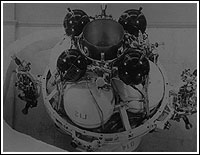
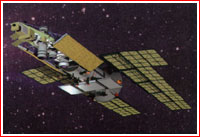
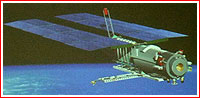
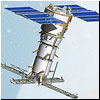
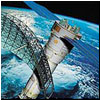
Soviet satellites developed within the MKRTs project: the US-A radar-carrying satellite (top left); the US-P electronic-intelligence satellite (middle right) and the Plazma-A experimental satellite with the Topaz thermo-emission power generator (bottom left).
At the time of Khrushchev's ascent,
the OKB-52 design bureau within the
Ministry of Aviation Industry, MAP, worked on the development of cruise missiles.
Not surprisingly, Vladimir Chelomei, the head
of OKB-52 soon found himself at the front of a
large-scale program aimed to equip the Soviet Navy with long-range cruise
missiles.
Concept
of MKRTs system
Although Soviet engineers were quickly able to advance the range and speed of cruise missiles, the improvements brought new technical challenges. The new
generation of Chelomei's missiles designated P-6 could now strike beyond
the range of radar installed on the ships which launched them. (34,
84) This meant that a new guidance system
was necessary if the Soviet Navy wanted to use the full capability of the new weapon.
It was Vladimir
Chelomei himself who offered the solution. He proposed space-based radar
and electronic intelligence spacecraft which could pinpoint the location
of enemy ships. After a series of preliminary studies, apparently initiated in
1959-1960 (70), the Soviet government
authorized the development of such system with two official decrees, issued
on June 23, 1960, and on March 16, 1961. (29)
During 1961,
the OKB-52 design bureau successfully completed the formal approval of the system and
in 1962, the organization completed the preliminary design of the system, composed of multiple satellites designated Upravlyaemy Sputnik ("controlled satellite") or US for short.
(29)
The overall system was called MKRTs and included two sub-systems which were designed to feed the targeting data to a
centralized control facility. The first sub-system included a network of
satellites designated US-P which were designed to intercept radio-signals
emitted by enemy ships. The letter "P" meant "passivniy"
(passive) as oppose to the second sub-system of the network consisting of US-A or "aktivniy"
(active) spacecraft. The
US-A satellites were to be equipped with radar to locate ships, even if they maintained total
"radio-silence" and would, therefore, remain undetectable for
the US-P satellites. (79)
Unlike many
other military systems, where the USSR struggled to catch up with the
West, the MKRTs-type network was a pioneering development. Its creation
testifies to how seriously the Soviet leadership was taking the threat coming
from the Western sea powers.
Nuclear power onboard
One of the most serious engineering challenges facing the developers of the US-P satellite was its power-hungry radar. The relative low efficiency of existing solar power-generating systems and their inability to produce electricity on the night side of the Earth forced spacecraft developers to seek help from their colleagues in the atomic industry, which worked on the miniaturization of nuclear reactors. There was hope that it would be possible to produce a nuclear-powered generator light and small enough to be installed aboard the satellite. Of course, the development of a portable nuclear power source for space posed huge technical challenges of its own, first of all in the area of safety.
The first Soviet nuclear generator for the US-P spacecraft became known as BES-5 Buk. It used the so-called thermal-electric principle -- the simplest method of converting the heat from the reactor into electricity. The development phases of the BES-5 Buk project were authorized by several decrees of the Soviet of Ministers: No. 258-110 on March 16, 1961, No. 702-295 on July 3, 1962, and No. 651-244 on August 24, 1965. Also, in 1963, the Soviet nuclear industry began work on more efficient but complex thermo-emission power sources, which became known as Topaz and Yenisei. (894)
The structure of the MKRTs
network
An official
Russian source (70), published
after the Cold War, revealed the existence of unnamed opposition to the
development of the specialized MKRTs system. The alternative proposals, apparently within the Ministry
of Defense, called for merging the proposed Navy orbital targeting system with the Tselina electronic-intelligence network which was under development at the same time. The Tselina system
was expected to intercept radio signals across a wide range of electromagnetic
spectrum, as oppose to MKRTs network, which was designed to primarily focus on frequencies used by the ships.
According
to critics of the MKRTs network, the "unified" system could
address the needs of all services within the armed forces including the
Soviet Navy. However, the competing interests within the Soviet Ministry
of Defense precluded the creation of such a "unified" constellation.
In addition, plans by the MKRTs developers to include the "active"
radar-carrying spacecraft into the network also favored the Navy-specific system.
A single ground control and data processing center was proposed to manage both, the US-A
and US-P sub-networks. That architecture allowed creating a centralized
guidance system for the Soviet sea-based missile forces.
Forming an industrial development team
The OKB-52
design bureau was the original "lead organization" in the development
of the MKRTs network, while the KB-1 bureau, subordinated
to the Ministry of Radio Industry, took responsibility for radio systems.
However, in 1964, KB-1 was assigned the overall responsibility for the system,
while OKB-52 became the primary developer of the US-A and US-P spacecraft for the
constellation.
By May 1969, OKB-52, (by then renamed NPO
Mashinostroenia) was finalizing the production of the design documentation for the US-A
spacecraft, however the documentation for the US-P system was not ready.
(79)
At the time, OKB-52, which had also started the
development of the Almaz orbital
station, and was involved in a number of other ambitious projects, had no production capacity for the serial manufacturing of US-A and -P satellites in the numbers required for the operational deployment and replenishment of the
network. As a result, the Leningrad-based KB Arsenal, previously specialized
in artillery and missile development, was brought into the project. On April
30, 1969, the Military Industrial Commission, VPK, within the Presidium of
the Soviet of Ministers made the official decision to assign KB Arsenal
the serial production of the US-A and US-P spacecraft.
Specifically for the project,
a special spacecraft division was formed within KB Arsenal. After the necessary
expansion and upgrades of its manufacturing and testing facilities in
Leningrad, KB Arsenal launched pilot production of the US-type spacecraft
in 1970.
Flight
testing
Vladimir
Chelomei originally proposed launching the US-A and US-P spacecraft, as well as the IS anti-satellite system, on a launch vehicle derived from OKB-52's UR-200 ballistic missile. With the cancellation
of the UR-200 program in 1964, both spacecraft were moved to a R-36-based
launcher, later known as Tsyklon-2. However,
because the US and IS systems were ready for flight tests before the Tsyklon-2 entered service, early spacecraft were adapted for the R-7-derived
launch vehicles.
On August
24, 1965, the Soviet government issued a decree clearing the way for
flight testing of the US-type spacecraft.
In 1965
and 1966, a two-stage version of the 11A510 (Voskhod) vehicle launched
two prototypes of the US-A spacecraft. During both missions, traditional
electrical batteries replaced the nuclear power generators eventually planned
for the spacecraft. (29)
Initial flight
testing was recognized as successful and another batch
of launches started at the end of 1967 with the specific purpose of trying out an upgraded design of the US-A spacecraft
which was capable of detaching and boosting its nuclear power source from its operational altitude to a much higher burial orbit.
In operation
The US-A
sub-system was declared operational in 1971 and the joint flight testing of the US-A spacecraft with the MKRTs system started at the end of 1970. Admiral N. N. Amelko led the State
Commission overseeing flight testing.
Launches for the operational use of the system commenced in 1975. According to KB Arsenal, a total of 36 US-A satellites and one US-AM were launched and 35 of them reached orbit. A total of 32 satellites carried the BES-5 Buk nuclear power source, but one of them did not make it into orbit. The two US-A spacecraft with operational nuclear power sources made emergency reentries, while 29 vehicles with BES-5 nuclear sources were boosted to burial orbits with altitudes between 700 and 800 kilometers. (893) However, a total of 10 reactor-carrying satellites experienced various malfunctions in orbit. (894)
The low reliability of the nuclear-powered energy sources was the main
reason for delays in the US-A flight test program. According to an
official Russian source, the short life span of US-A satellites and reliability problems prevented the full-scale deployment of the US-A sub-system. (70)
In 1987, within the Plazma-A experimental program, two 3.5-ton satellites, under official names Kosmos-1818 and -1867, were launched into a 800-kilometer orbit with an inclination 65 degrees toward the Equator. They were equipped with the TEU Topaz reactors, which used fast-neutron thermo-emission principle instead of the Buk thermo-electric units on previous satellites. Kosmos-1818 and 1867 functioned for 120 and 342 days respectively and flight testing of the Topaz power generators was later described as promising, but in 1988, further launches of US-A spacecraft equipped with nuclear sources of power had been discontinued.
The US-P spacecraft and their modifications, known as US-PM and US-PU,
continued flying at the turn of the 21st century and the last satellite in the series was launched in June 2006. According to KB Arsenal, a total of 50 US-P satellites were launched, 49 of them reached orbit and 48 functioned. Among manufactured satellites 23 were US-P version, 17 were US-PM (16 of them functioned) and 10 were US-PU. (893)
Follow-on
to MKRTs
In 1978,
TsNII Kometa started development of the second-generation MKRTs system,
completing technical proposals in 1979 and 1980. In June 1981,
the Soviet government issued a decree authorizing development of the follow-on
MKRTs system, known as Ideogramma-Pirs. It called for a two-phase development
schedule, including a preliminary design of the sub-system for detecting surface
vessels and technical proposals for a much more sophisticated sub-system, whose satellites would be able to locate
submerged vessels. The government asked for bids to develop the spacecraft for the new MKRTs from NPO Energia in Podlipki near Moscow, from Leningrad-based PO Arsenal and Kuibyshev-based TsKBM, the
developer of the Yantar reconnaissance satellites.
In 1982,
PO Arsenal completed the preliminary design of the Ideogramma-Pirs system.
After reviewing the project, an inter-agency commission approved its development
schedule on December 12, 1982. Fleet Admiral S. G. Gorshkov, the Chief
Commander of the Soviet Navy played a key role in moving the project forward.
According to an official Russian source (76),
Gorshkov helped resolve disagreements between the Russian Space Forces, GUKOS,
and the Soviet Navy, VMF, on one side and the Ministry of General Machine-building, MOM, and the Ministry of Radio Industry, Minradioprom, on the other, over the
subject of allocating contracts and development responsibilities in the MKRTs project.
The first
phase of the project called for the development of the operational Pirs-1
complex, while during the second stage, an experimental complex, code-named
Forvater, would be launched. By 1983, TsNII Kometa was expected to complete
technical proposals for the overall system and PO Arsenal for the spacecraft
itself. In September 1982, the Soviet Navy issued a technical assignment for the overall
system, and in September 1983, GUKOS issued a technical assignment for the
spacecraft.
TsNII Kometa
and PO Arsenal submitted technical proposals for the system during 1983.
This time, however, there was a conflict between the technical proposals
on the spacecraft and the overall system, due to disagreements between
MOM and Minradioprom. Finally, in December 1984, the government decreed
that the first phase of the project to be completed by 1990, and the second stage
by 1993.
For the next-generation of the naval electronic-intelligence satellite, KB Arsenal was working on a new platform
which would be launched on a Zenit-2 rocket.
However, with the disintegration of the USSR, which left the production of the Zenit rockets in the newly independent republic of Ukraine, the prospective platform had to be re-tailored
for the smaller Soyuz-2 launcher. (110)
Recent
launches
2001 Dec.
21: After a two-day delay, a Ukrainian-built Tsyklon-2
booster successfully delivered a Russian electronic intelligence spacecraft
on Friday.
A 182-ton
two-stage rocket lifted off from Site 90 in Baikonur at 07:00 Moscow Time on December 21. The
rocket successfully inserted the spacecraft into a transfer orbit with
an apogee of 400 kilometers. The satellite, officially designated Kosmos-2383,
was then expected to use its own propulsion system to reach a final orbit
around 07:48 Moscow Time on December 21. The rocket was carrying a US-PU
satellite built by KB Arsenal development center in St. Petersburg and
designed to provide electronic intelligence and missile guidance information
for the Russian Navy.
During his
visit to KB Arsenal in St. Petersburg in 2001, the commander of the Russian
Space Forces, VKS, General Perminov indicated that another US-P spacecraft
would be launched before the end of the year.
This was
the first launch of the US-type spacecraft since December 1999 and the
104th launch of the Tsyklon-2 booster.
2004
May 28: Russia launched a classified military payload to monitor foreign
Navy activities. According to the Russian Space Forces, KVR, a Tsyklon-2 rocket carrying a Kosmos-series satellite
lifted off from Baikonur Cosmodrome at 10:00 Moscow Time. Four minutes
later, the spacecraft separated from the upper stage of the launch vehicle.
The payload was identified as Kosmos-2405. This mission was originally expected at the end
of 2002.
2006 June 25: Russian military received a new spacecraft for orbital electronic intelligence, ELINT.
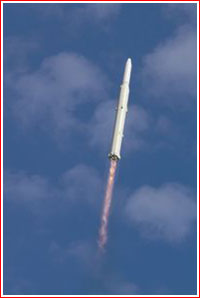
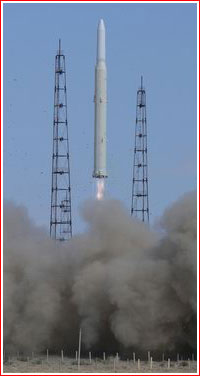
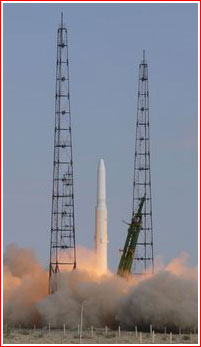
The Tsyklon-2 rocket lifted off from Site 90 in Baikonur Cosmodrome on June 25, 2006, at 08:00 Moscow Time.
An official statement by the Russian space agency, Roskosmos, said only that the launch vehicle had carried a payload for the Ministry of Defense and the mission had proceeded nominally. It is known that Tsyklon-2's missions from Baikonur carry electronic intelligence satellites of the US-PU family. The previous spacecraft of this type was deorbited on April 28, 2006.
This mission was previously expected to take off on June 22, 2006. The spacecraft was officially designated as Kosmos-2421.
On July 3, 2006, the Kommersant newspaper reported that the satellite had failed to deploy one of its two solar panels, leaving the spacecraft without enough power to perform its nominal tasks. Flight controllers reportedly spent a week commanding the satellite to conduct a number of maneuvers in an effort to force the panel to deploy, but without much success. At the time, KB Arsenal, the spacecraft developer, still hoped to solve the problem, the newspaper said.
The Kommersant article was followed by a publication from the official ITAR-TASS news agency which said that two out of eight solar panels had failed to deploy and that, after an additional effort by ground control, one of two failed panels had deployed. Controllers continued working on solving the problem which did not affect overall performance of the spacecraft, the statement said.
On July 12, 2006, Roskosmos disclosed that Kosmos-2421 carried the KONUS-A piggyback science payload, developed by Yoffe FizTekh Institute and designed to detect gamma-ray bursts.
Kosmos-2421 apparently ceased to function on March 14, 2008. It then moved away from its operational orbit on Feb. 16, 2008, and disintegrated around March 19, 2008, generating more than 500 detectable debris.
The MKRTs project industrial development team:
| Overall
design |
KB-1
(OKB-41/TsNII Kometa) |
A.
I. Savin |
Moscow |
| The
US spacecraft |
OKB-52 |
Vladimir
Chelomei |
Reutov |
| US spacecraft
production |
KB
Arsenal |
Vladimir
Kalabin |
Leningrad |
| US-A
radar system |
NII
Priborostroenia |
I.
A. Brukhanskiy, P. O. Salgavik |
Moscow |
| US-P
ELINT system |
NIRTI
(Minradioprom) |
S.
I. Baburin, V. L. Grechka |
Kaluga |
| US spacecraft
propulsion system |
Turaevskoe
MKB Soyuz (Minaviaprom) |
V.
G. Stepanov, D. D. Gelevich |
Lutkarino |
| US spacecraft
attitude control system |
TsKB
Almaz (Minradioprom) |
P.
M. Kirillov |
- |
| US spacecraft
telemetry system |
NII
Priborostroenia (MOM) |
V.
V. Khramov, V. B. Kharin |
- |
| Nuclear
power generator |
OKB-670
(NPO Krasnaya Zvezda) |
M.
M. Bondaryuk, G.M. Gryaznov, V.I. Serbin |
Moscow |
Overview of US-A/P
spacecraft versions:
| US-A |
ER |
Original version with Buk nuclear power generator |
| US-AM |
ERM |
Upgraded version with Buk-3 nuclear generator first launched in July 1987 |
| ? |
E1 |
Radar satellite equipped with solar panels |
| ? |
E1M |
Radar satellite with solar panels |
| US-P |
E2 |
Original version of electronic intelligence satellite |
| US-PM |
E2M |
Upgraded version ELINT satellite introduced in 1985 |
| US-PU |
E2U |
Upgraded version of ELINT satellite introduced in 1988 |
| ? |
E2N |
Upgraded spacecraft for the Zenit rocket |
| Plazma-A |
E3A |
An experimental satellite with a Topol and Topaz nuclear generator |
| ? |
E4 |
Upgraded spacecraft for the Zenit rocket |
Launches
of spacecraft in the US-A/P series:
The Tsyklon-2
rocket (variants 11K67 and 11K69), launched from Site 90 in Baikonur delivered
all but first two spacecraft.
| 1965
Dec. 28 |
Kosmos-102 |
218x278 |
17* |
US
bus |
A prototype
launched on a Voskhod/11A510 launcher. According to KB Arsenal, the mission aimed to conduct autonomous test of the spacecraft without BES-5 power source and a radar. The launch also had to test operation of SOS and the main propulsion system. The spacecraft functioned for one orbit. (893) |
| 1966
July 20 |
Kosmos-125 |
250x250 |
- |
US
bus |
A prototype
launched on a Voskhod/11A510 launcher. According to KB Arsenal, the mission aimed to conduct autonomous test of the spacecraft without BES-5 power source and a radar. The launch also had to test operation of SOS and the main propulsion system. The spacecraft functioned for eight orbits. (893) |
| 1967
Dec. 27 |
Kosmos-198 |
281x265 |
2 |
US-A |
Phase
II in testing. Launched by the 11K67 vehicle. According to KB Arsenal, the mission aimed to conduct autonomous test of the spacecraft with a mockup of the BES-5 power source and the transfer of the reactor to the "dissipation" (burial) orbit. The spacecraft functioned for 13.5 orbits. (893) |
| 1968
March 22 |
Kosmos-209 |
282x250 |
6 |
US-A |
Phase
II in testing. Launched by the 11K67 vehicle. According to KB Arsenal, the mission aimed to conduct autonomous test of the spacecraft with a mockup of the BES-5 power source and the transfer of the reactor to the "dissipation" (burial) orbit. The spacecraft functioned for 8.5 orbits. (893) |
| 1969
Jan. 25 |
- |
- |
- |
US-A |
Phase
II in testing. According to KB Arsenal, the mission aimed to conduct autonomous test of the spacecraft with a mockup of the BES-5 power source and the transfer of the reactor to the "dissipation" (burial) orbit. The spacecraft failed to reach orbit due to failure of the 11K67 vehicle. |
| 1970
Oct. 3 |
Kosmos-367 |
280x250 |
- |
US-A |
According to KB Arsenal, the mission called for integrated tests of the spacecraft and the MKRTs system. (893) Failed
shortly after reaching orbit (34) The first Soviet vehicle equipped with a BES-5/Buk nuclear reactor (Serial No. 31) operated for only 110 minutes (1.5 orbit) due to overheating of the main loop as a result of the melting of the reactor core. The reactor was then boosted to a burial orbit. (894)
|
| 1971
April 1 |
Kosmos-402 |
279x261 |
8 |
US-A |
According to KB Arsenal, the mission called for joint tests of the spacecraft and the MKRTs system. The satellite functioned for two orbits. (893) |
| 1971
Dec. 25 |
Kosmos-469 |
276x259 |
10 |
US-A |
According to KB Arsenal, the mission called for joint tests of the spacecraft and the MKRTs system. The satellite functioned for nine days. (893) |
| 1972
Aug. 21 |
Kosmos-516 |
277x256 |
31 |
US-A |
According to KB Arsenal, the mission called for joint tests of the spacecraft and the MKRTs system. The satellite functioned for 32 days. (893) |
| 1973
April 25 |
- |
- |
- |
US-A |
Failure
of the launch vehicle (?). According to KB Arsenal, the mission called for joint tests of the spacecraft and the MKRTs system, but the satellite fell into the Pacific Ocean with inactive reactor. (893) |
| 1973
Dec. 27 |
Kosmos-626 |
280x257 |
46 |
US-A |
First
US-A spacecraft manufactured at KB Arsenal. (79) According to the company, the mission called for joint tests of the spacecraft and the MKRTs system along with routine operations. The spacecraft functioned for 45 days (893) and experienced a malfunction. (894) |
| 1974
May 15 |
Kosmos-651 |
276x256 |
71 |
US-A |
According to KB Arsenal, the mission called for joint tests of the spacecraft and the MKRTs system along with routine operations. The spacecraft functioned for 71 days (893) and experienced a malfunction. (894) |
| 1974
May 17 |
Kosmos-654 |
277x261 |
74 |
US-A |
According to KB Arsenal, the mission called for joint tests of the spacecraft and the MKRTs system along with routine operations. The spacecraft functioned for 75 days. (893) |
| 1974
Dec. 24 |
Kosmos-699 |
454x436 |
- |
US-P |
The first
US-P spacecraft manufactured at KB Arsenal. (79)
Exploded on April 17, 1975. (34)
Reportedly, it maneuvered in March 1975, destroyed in April and August
1975. (147) According to KB Arsenal, the spacecraft functioned for 80 days and its mission included integrated tests of the US-P satellite and the overall system. Also, the Kortik-S payload and the propulsion system had been tested. (893) |
| 1975
April 2 |
Kosmos-723 |
277x256 |
46 |
US-A |
According to KB Arsenal, it was the first fully operational use of the US-A satellite. The spacecraft functioned for 44 days. (893) |
| 1975
April 7 |
Kosmos-724 |
276x258 |
65 |
US-A |
According to KB Arsenal, it was operational launch of the US-A satellite. The spacecraft functioned for 65 days (893) and experienced a malfunction. (894) |
| 1975
Oct. 29 |
Kosmos-777 |
456x437 |
- |
US-P |
Exploded
in January 1976. According to KB Arsenal, the mission called for joint tests of the spacecraft and the overall system along with regular operations and testing of the panel opening of the Kortik-S instrument. The spacecraft functioned for 75 or 89 days. (893) |
| 1975
Dec. 12 |
Kosmos-785 |
278x259 |
1 |
US-A |
According to KB Arsenal, it was an operational launch of the US-A satellite. The spacecraft functioned for four orbits, before the unsanctioned activation of the deorbiting sequence. (893) According to (894), during the mission was the first fully successful operation of the BES-5/Buk reactor. |
| 1976
July 2 |
Kosmos-838 |
456x438 |
- |
US-P |
Exploded
in the Summer of 1977. According to KB Arsenal, the spacecraft functioned for 131 days and its mission included testing of the Ritm payload for detecting surface ships and integrated tests of the spacecraft and overall system. (893) |
| 1976
Oct. 17 |
Kosmos-860 |
278x260 |
24 |
US-A |
According to KB Arsenal, it was operational launch of the US-A satellite. The spacecraft functioned for 24 days (893) and experienced a malfunction. (894) |
| 1976
Oct. 21 |
Kosmos-861 |
280x256 |
60 |
US-A |
According to KB Arsenal, it was operational launch of the US-A satellite. The spacecraft functioned for 60 days. (893) |
| 1976
Nov. 26 |
Kosmos-868 |
457x438 |
- |
US-P |
According to KB Arsenal, the spacecraft functioned for 35 days and its mission included testing of the Ritm payload for detecting surface ships and integrated tests of the system. (893) |
| 1977
Aug. 24 |
Kosmos-937 |
457x438 |
- |
US-P |
According to KB Arsenal, the spacecraft functioned for 153 days and its mission included routine operations and testing of the Ritm payload for detecting surface ships. (893) |
| 1977
Sept. 16 |
Kosmos-952 |
278x258 |
22 |
US-A |
According to KB Arsenal, it was operational launch of the US-A satellite. The spacecraft functioned for 21 day. (893) |
| 1977
Sept. 18 |
Kosmos-954 |
277x251 |
- |
US-A |
According to KB Arsenal, it was operational launch of the US-A satellite. (893) The spacecraft functioned for 110 days, before making an emergency reentry
over Canada, resulting in radioactive contamination of the impact site. |
| 1979
April 18 |
Kosmos-1094 |
457x437 |
- |
US-P |
Operated
in pair? According to KB Arsenal, it was an operational mission that lasted 30 days. (893) |
| 1979
April 25 |
Kosmos-1096 |
457x439 |
- |
US-P |
Operated
in pair? According to KB Arsenal, it was an operational mission that lasted 65 days. (893) |
| 1980
March 14 |
Kosmos-1167 |
457x433 |
372 |
US-P |
Worked
in parallel with Kosmos-1176 and Kosmos-1220. (147) According to KB Arsenal, it was an operational mission that lasted 165 days. (893) |
| 1980
April 29 |
Kosmos-1176 |
265x260 |
134 |
US-A |
According to KB Arsenal, it was operational launch of a US-A satellite which also included testing of the Additional Radiation Safety System, DSRB. The satellite operated for 134 days. (893) |
| 1980
Nov. 4 |
Kosmos-1220 |
454x432 |
145 |
US-P |
Orbit
inclination was shifted three degrees relative to the one of Kosmos-1167's.
(147) Reentered on Feb. 16, 2014 at 05:58 Moscow Time. According to KB Arsenal, it was an operational mission that lasted 124 days. (893) |
| 1981
March 5 |
Kosmos-1249 |
264x251 |
106 |
US-A |
According to KB Arsenal, it was operational launch of a US-A satellite which also included testing of the Additional Radiation Safety System, DSRB. The satellite operated for 107 days. (893) |
| 1981
March 21 |
Kosmos-1260 |
447x428 |
176 |
US-P |
Operated
in pair with Kosmos-1286. According to KB Arsenal, it was an operational mission that lasted 92 days. (893) |
| 1981
April 21 |
Kosmos-1266 |
267x248 |
8 |
US-A |
Failure. According to KB Arsenal, it was operational launch of a US-A satellite. The spacecraft functioned for eight days. (893) |
| 1981
Aug. 4 |
Kosmos-1286 |
444x431 |
224 |
US-P |
Operated
in pair with Kosmos-1260. According to KB Arsenal, it was an operational mission that lasted 85 days. (893) |
| 1981
Aug. 24 |
Kosmos-1299 |
266x247 |
13 |
US-A |
Failure. According to KB Arsenal, it was operational launch of a US-A satellite. The spacecraft functioned for 13 days. (893) |
| 1981
Sept. 14 |
Kosmos-1306 |
424x171 |
150 |
US-P |
Speculated
booster problem resulted in a lower orbit, which was raised after
8 days. Replaced Kosmos-1260. According to KB Arsenal, it was an operational mission that lasted 101 day. (893) |
| 1982
Feb. 11 |
Kosmos-1337 |
446x428 |
8 |
US-P |
Operated
in pair with Kosmos-1286 and 1306. Failure of the propulsion or flight
control system. (147) According to KB Arsenal, it was an operational mission that failed after three orbits. (893) |
| 1982
April 29 |
Kosmos-1355 |
446x428 |
249 |
US-P |
According to KB Arsenal, it was an operational mission that lasted 187 days. (893) |
| 1982
May 14 |
Kosmos-1365 |
264x252 |
136 |
US-A |
Worked
in pair with Kosmos-1372 (147). According to KB Arsenal, it was operational launch of a US-A satellite. The spacecraft functioned for 136 days. (893) |
| 1982
June 2 |
Kosmos-1372 |
270x246 |
71-72 |
US-A |
Worked
in pair with Kosmos-1365. (147) According to KB Arsenal, it was operational launch of a US-A satellite. The spacecraft functioned for 72 days. (893) |
| 1982
Aug. 30 |
Kosmos-1402 |
264x251 |
120 |
US-A |
Failed
in orbit. Reentered in 1983. (147) According to KB Arsenal, it was operational launch of a US-A satellite. The spacecraft functioned for 121 days before making an emergency reentry with the activation of the Additional Radiation Safety System, DSRB. The impact took place in the Southern section of the Atlantic Ocean. (893) |
| 1982
Sept. 4 |
Kosmos-1405 |
444x430 |
91 |
US-P |
According to KB Arsenal, it was an operational mission that lasted 41 days. (893) |
| 1982
Oct. 2 |
Kosmos-1412 |
266x251 |
39 |
US-A |
According to KB Arsenal, it was operational launch of a US-A satellite. The spacecraft functioned for 40 days. (893) |
| 1983
May 7 |
Kosmos-1461 |
444x429 |
268 |
US-P |
Disintegrated in 1985 into around 180 fragments. According to KB Arsenal, it was an operational mission that lasted 193 days. (893) |
| 1983
Oct. 29 |
Kosmos-1507 |
442x433 |
222 |
US-P |
According to KB Arsenal, it was an operational mission that lasted 107 days. (893) |
| 1984
May 30 |
Kosmos-1567 |
442x432 |
538 |
US-P |
According to KB Arsenal, it was an operational mission that lasted 260 days. (893) |
| 1984
June 29 |
Kosmos-1579 |
264x249 |
125 |
US-A |
According to KB Arsenal, it was operational launch of a US-A satellite. The spacecraft functioned for 90 days. (893) |
| 1984
Aug. 7 |
Kosmos-1588 |
446x426 |
341 |
US-P |
According to KB Arsenal, it was an operational mission that lasted 307 days. (893) |
| 1984
Oct. 31 |
Kosmos-1607 |
264x250 |
93 |
US-A |
According to KB Arsenal, it was operational launch of a US-A satellite. The spacecraft functioned for 94 days. (893) |
| 1985
Jan. 23 |
Kosmos-1625 |
370x116 |
- |
US-PM |
Speculated
failure of the 2nd stage re-ignition. Reentered after few hours. According to KB Arsenal, the mission aimed to test the upgraded US-PM spacecraft with the overall system. The spacecraft failed to reach an operational orbit. (893) |
| 1985
April 18 |
Kosmos-1646 |
443x429 |
312 |
US-P |
Exploded
in orbit. (147) According to KB Arsenal, it was an operational mission that lasted 65 days. (893) |
| 1985
Aug. 1 |
Kosmos-1670 |
264x252 |
83 |
US-A |
According to KB Arsenal, it was operational launch of a US-A satellite. The spacecraft functioned for 83 days (893) and experienced a malfunction. (894) |
| 1985
Aug. 23 |
Kosmos-1677 |
263x251 |
61 |
US-A |
According to KB Arsenal, it was operational launch of a US-A satellite. The spacecraft functioned for 60 days (893) and experienced a malfunction. (894) |
| 1985
Sept. 19 |
Kosmos-1682 |
370x116 |
382 |
US-P |
Speculated
failure of the 2nd stage re-ignition. Reentered after few hours. According to KB Arsenal, it was an operational mission that lasted 382 days. (893) |
| 1986
Feb. 27 |
Kosmos-1735 |
- |
613 |
US-PM |
First
(successfully launched) US-P-type (US-PM) spacecraft developed at KB Arsenal. (79) According to KB Arsenal, it was an integrated tests of the upgraded US-PM spacecraft with the system along with operational use. The spacecraft operated for 535 days. (893) |
| 1986
March 21 |
Kosmos-1736 |
- |
92 |
US-A |
Failed
in orbit (?). According to KB Arsenal, it was operational launch of a US-A satellite. The spacecraft functioned for 92 days. (893) |
| 1986
March 24 |
Kosmos-1737 |
- |
254 |
US-P |
According to KB Arsenal, it was an operational US-P mission that lasted 254 days. (893) |
| 1986
Aug. 4 |
Kosmos-1769 |
- |
367 |
US-P |
(147) According to KB Arsenal, it was an operational US-P mission that lasted 367 days. (893) |
| 1986
Aug. 20 |
Kosmos-1771 |
- |
56 |
US-A |
Deorbited
on Oct. 15, 1986. (147) According to KB Arsenal, it was operational launch of a US-A satellite. The spacecraft functioned for 55 days. (893) |
| 1987
Feb. 2 |
Kosmos-1818 |
|
142 |
US-A |
Launched with a new Topaz thermo-emission nuclear power unit within the Plazma-A experimental program, replacing the Buk thermoelectric source in the previous models. In January 2009, chief of Russian space forces essentially confirmed US reports (320) that on or about July 4, 2008, the spacecraft released a cloud of around 30 small fragments, possibly droplets of sodium-potassium coolant from its nuclear reactor. Due to a low speed of fragments relative to the main satellite not exceeding 15 meters per second, a major explosion was ruled out. Kosmos-1818 was expected to decay in 2045. According to KB Arsenal, the spacecraft functioned for 120 days. (893) |
| 1987
April 8 |
Kosmos-1834 |
- |
- |
US-PM |
(147) According to KB Arsenal, it was an integrated test of the upgraded US-PM spacecraft with the system along with operational use. The spacecraft operated for 509 days. (893) |
| 1987
June 18 |
Kosmos-1860 |
- |
40 |
US-A |
(147). According to KB Arsenal, it was operational launch of a US-A satellite. The spacecraft functioned for 38 days. (893) |
| 1987
July 10 |
Kosmos-1867 |
|
342 |
US-A |
First US-AM version. Equipped with a new thermo-emission nuclear power unit, Buk-3/Topaz, rather than a thermoelectric one in the previous models. (320) |
| 1987
Oct. 10 |
Kosmos-1890 |
- |
- |
US-P |
(147) According to KB Arsenal, it was an operational mission that lasted 423 days. (893) |
| 1987
Dec. 12 |
Kosmos-1900 |
- |
128 |
US-A |
Failed
in orbit. First US-A-type spacecraft developed at KB Arsenal. (79)
Deorbited after uncontrolled descent. (147). According to KB Arsenal, it was a test launch the US-AM satellite variant with an upgraded BES-5 nuclear power system. The spacecraft functioned for 74 days (893) and experienced a malfunction. (894) |
| 1988
March 14 |
Kosmos-1932 |
- |
66 |
US-A |
Last
US-A. Deorbited May 19, 1988. According to KB Arsenal, it was operational launch of a US-A satellite. The spacecraft functioned for 68 days. (893) |
| 1988
May 28 |
Kosmos-1949 |
- |
662 |
US-PU |
According to KB Arsenal, it was an integrated test of the upgraded US-PU spacecraft with the system along with operational use. The spacecraft operated for 662 days. (893) |
| 1988
Nov. 18 |
Kosmos-1979 |
- |
374 |
US-PM |
According to KB Arsenal, it was an operational US-PM mission that lasted 118 days. (893) |
| 1989
July 24 |
Kosmos-2033 |
- |
516 |
US-PM |
According to KB Arsenal, it was an operational US-PM mission that lasted 518 days. (893) |
| 1989
Sept. 27 |
Kosmos-2046 |
- |
560 |
US-PU |
According to KB Arsenal, it was an integrated test of the upgraded US-PU spacecraft with the system along with operational use. The spacecraft operated for 562 days. (893) |
| 1989
Nov. 24 |
Kosmos-2051 |
- |
625 |
US-PM |
According to KB Arsenal, it was an operational US-PM mission that lasted 261 days. (893) |
| 1990
March 14 |
Kosmos-2060 |
- |
- |
US-PM |
According to KB Arsenal, it was an operational US-PM mission that lasted 526 days. (893) |
| 1990
Aug. 23 |
Kosmos-2096 |
- |
- |
US-PM |
Replaced
Kosmos-2051. (147) According to KB Arsenal, it was an operational US-PM mission that lasted 495 days. (893) |
| 1990
Nov. 14 |
Kosmos-2103 |
- |
- |
US-PM |
Apparently
failed on Jan. 2, 1991, after functioning for 49 days. Reentered on
April 3, 1991, while out of control. According to KB Arsenal, it was an operational US-PM mission that lasted 59 days. (893) |
| 1990
Dec. 4 |
Kosmos-2107 |
- |
- |
US-PM |
According to KB Arsenal, it was an operational US-PM mission that lasted 463 days. (893) |
| 1991
Jan. 18 |
Kosmos-2122 |
- |
- |
US-PU |
According to KB Arsenal, it was an operational US-PU mission that lasted 777 days. (893) |
| 1993
March 30 |
Kosmos-2238 |
- |
- |
US-PM |
According to KB Arsenal, it was an operational US-PM mission that lasted 541 days. (893) |
| 1993
April 28 |
Kosmos-2244 |
- |
657 |
US-PU |
According to KB Arsenal, it was an operational US-PM mission that lasted 666 days. (893) |
| 1993
July 7 |
Kosmos-2258 |
- |
603 |
US-PU |
According to KB Arsenal, it was an operational US-PM mission that lasted 604 days. (893) |
| 1993
Sept. 17 |
Kosmos-2264 |
- |
564 |
US-PU |
According to KB Arsenal, it was an operational US-PM mission that lasted 534 days. (893) |
| 1994
Nov. 2 |
Kosmos-2293 |
- |
510 |
US-PU |
According to KB Arsenal, it was an operational US-PM mission that lasted 510 days. (893) |
| 1995
June 8 |
Kosmos-2313 |
- |
684 |
US-PU |
Desintegrated
on June 26, 1997. According to KB Arsenal, it was an operational US-PM mission that lasted 685 days. (893) |
| 1995
Dec. 20 |
Kosmos-2326 |
- |
660 |
US-PU |
According to KB Arsenal, it was an operational US-PU mission that lasted 660 days. The satellite also carried a Konus-A scientific payload. (893) |
| 1996
Dec. 11 |
Kosmos-2335 |
- |
726 |
US-PU |
According to KB Arsenal, it was an operational US-PU mission that lasted 728 days. (893) |
| 1997
Dec. 9 |
Kosmos-2347 |
- |
710 |
US-PU |
According to KB Arsenal, it was an operational US-PU mission that lasted 712 days. (893) Desintegrated
on Nov. 22, 1999. |
| 1999
Dec. 26 |
Kosmos-2367 |
- |
- |
US-PU |
According to KB Arsenal, it was an operational US-PU mission that lasted 701 day. Additionally, the satellite carried a Konus-A science instrument. (893) |
| 2001
Dec. 21 |
Kosmos-2383 |
- |
- |
US-PU |
According to KB Arsenal, it was an operational US-PU mission that lasted 792 days. (893) 13
fragments detected in March 2004. |
| 2004
May 28 |
Kosmos-2405 |
- |
- |
US-PU |
Mission
delayed from the end of 2002(?). According to KB Arsenal, it was an operational US-PU mission that lasted 741 days. (893) Deorbited on April 28, 2006. |
| 2006
June 25 |
Kosmos-2421 |
- |
- |
US-PU |
The launch
was delayed from June 22, 2006. According to KB Arsenal, it was an operational US-PU mission that lasted 604 days. (893) Carried a Konus-A gamma-ray detector. |
Next chapter: Liana network
|

|