|
|
|
||||||||||||||||||||||||||||||||||||||||||||||||||||||||||||||||||||||||||
     
|
Russia to launch a dual-use satellite cluster A Soyuz-2-1b/Fregat rocket made its first and only launch from Vostochny spaceport in 2026, carrying a new pair of high-resolution imaging satellites, along with a cluster of smaller payloads, on Nov. 14, 2026, in the midst of increasing secrecy around space activities in the country. KOEN launch on Nov. 14, 2026, at a glance:
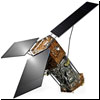
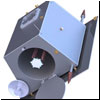
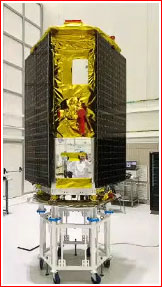
During its launch at the end of 2026, the Soyuz-2 rocket was expected to carry a cluster of satellites from at least four startups, operating outside of Roskosmos. The primary payload included the half-a-ton KOEN imaging satellite (INSIDER CONTENT) developed by a company known as Stilsoft or Stilspeis in cooperation with an organization called MT-Lab. KOEN was expected to ride into orbit as a pair with the Kinosputnik (INSIDER CONTENT), a 300-kilogram imager developed at Sputniks. Additionally, the rocket was expected to deliver a pair of cubesat-class satellites for NPO Kaisant. The company boasted that its "modems" installed aboard the latest addition to its orbital constellation would be used for secure communications with drones supporting the Russian invasion of Ukraine. Finally, the STTs center was known to book launch of at least six of its small satellites on the same mission. Summary of known payloads aboard the Soyuz launch on Nov. 14, 2026:
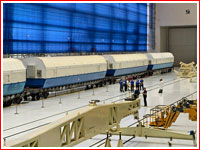
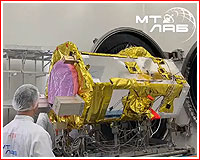
Launch campaign As of early 2026, the KOEN/Kinosputnik cluster launch was expected on Sept. 2, 2026, but by the middle of the year, it was reported to be postponed until the November-December period. A Fregat upper stage, likely assigned to this mission, was reported to be delivered to Vostochny airport on July 10, 2026. It marked the first landing of the An-124-100 Ruslan transport aircraft at the new runway of the space center. On July 22, 2026, Roskosmos announced the arrival of a train at Vostochny with the components of a Soyuz-2 rocket and its payload fairing also likely intended for this mission. On Sept. 22, 2026, Roskosmos head Dmitry Bakanov, likely referring to MKA Kinosputnik (INSIDER CONTENT) and KOEN projects, reported to Prime Minister Mikhail Mishustin that two "private" satellites for optical electronic observation had already been delivered to Vostochny for a planned launch in the following month. No other details on the launch campaign had been published in the midst of the overall crackdown on public information across the space industry, but local authorities in the Russian Far East did issue travel restrictions for the population, in particular near the Aldan drop zone in the Yakut Republic, due to an expected rocket launch scheduled for Nov. 14, 2026, at 10:16 local time (04:16 Moscow Time). Around the same time, the MT-Lab startup published photos of the KOEN satellite undergoing pre-launch processing in Vostochny. Launch profile 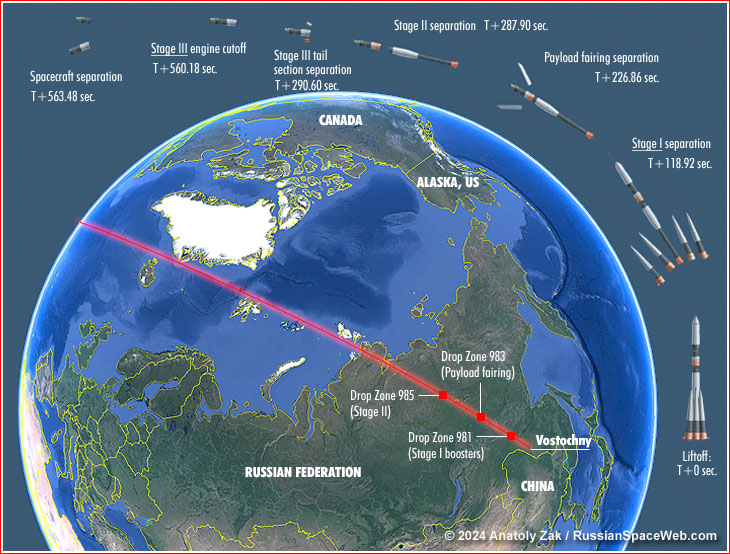 A Soyuz-2.1b rocket lifted off from Site 1S in Vostochny on Nov. 14, 2026, at 04:16 Moscow Time (8:16 p.m. EST on November 13). After a few seconds of vertical ascent under the power of the four boosters of the first stage and the core booster of the second stage, the rocket was expected to head northwest across Russian Far East, aligning its trajectory with a near-polar orbit. The strap-on boosters of the first stage were to separate around 1 minute 59 seconds after liftoff in order to crash at Drop Zone No. 981 in the Amurskaya Oblast (Amur Region) on the border between the Tynda and Zeya Districts. The fairing protecting the payload split in two halves and likely separated during the operation of the second stage at 3 minutes 48 seconds in flight. As a result, the payload fairing fragments were to fall at Drop Zone No. 983 in the Aldan District in the Sakha (Yakut) Republic. Moments before the second stage was to complete its firing around 4 minutes and 48 seconds into the flight, the RD-0124 engine of the third stage was expected to begin to fire through the inter-stage lattice structure, which moments later separated along with the second stage around 4 minutes and 48 seconds after liftoff. Just 1.5 seconds later, the tail section on the third stage split into three segments. Both, the second-stage booster and the segments of the tail section were projected to impact the ground at Drop Zone No. 985, in the Vilyusk District, located farther north in the Sakha Republic. The third stage continued firing, aiming to insert the Fregat upper stage and its passengers into an initial orbit with an apogee (highest point) around 196 kilometers above the Earth and a perigee well in the dense atmosphere. As a result, after its engine cutoff and separation from Fregat, around 9 minutes 24 seconds after liftoff, the third stage was to begin a long free fall back to Earth over the Arctic and Northern Atlantic Oceans. Its trajectory was usually designed to bring the flaming debris of the booster crashing into the Atlantic Ocean. Space tug flight profile Following its split from the third stage, the Fregat is usually programmed to fire its engine over the Arctic Region around 9 minutes 29 seconds after liftoff for around 1.5 minutes to ensure its insertion into an initial transfer orbit. The stack will then climb passively for around 46 minutes before Fregat fires for the second time near the apogee of its initial orbit, this time over the Antarctica, around 59 minutes 40 seconds after liftoff. The maneuver, lasting less than a minute, is designed to insert the vehicle into a nearly circular orbit. The primary payload is then ejected from Fregat's payload adapter, completing the main task of the mission. Fregat can then perform additional maneuvers before releasing secondary payloads into their prescribed orbits. The space tug is then programmed to deorbit itself over the Pacific Ocean during its fourth orbit.
|
|
||||||||||||||||||||||||||||||||||||||||||||||||||||||||||||||||||||||||

|