|
|
  
|
Soyuz launches a military payload
A Soyuz-2 launch vehicle lifted off from Plesetsk on April 3, 2026, carrying a classified payload, likely to be the 11th flight of a Meridian military communications satellite. 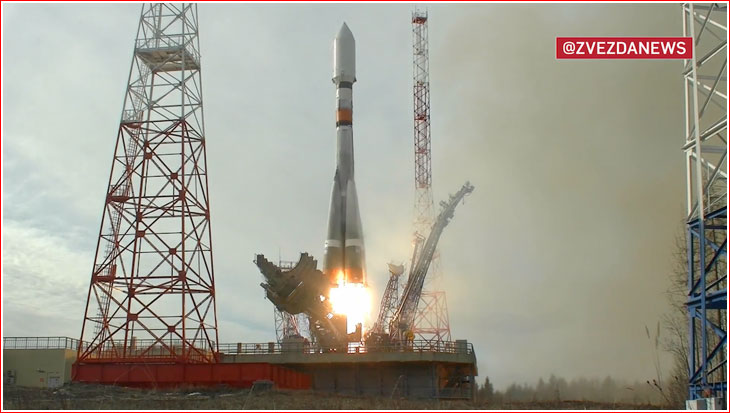
The 11th Meridian mission at a glance:
On March 26, 2026, local emergency services in the Komi Republic announced danger zones in three areas routinely used as impact sites for Soyuz-2 rocket launches, including the "Vashka" site in the Udorsky District, and the "Zheleznodorozhny" site in the Knyazhpogostsky and Kortkerossky districts. According to the warning, the launch of the Soyuz-2 rocket was planned between April 1 and April 15, 2026, between 02:00 and 12:00. For the same time frame, the Russian authorities issued notification to air and sea traffic for a section of the Pacific Ocean, which would typically be used for the splashdown of the empty third stage of the Soyuz-2 rocket. A section of the Pacific, Southeast of Tasmania and Southwest of New Zealand was closed off, likely for the controlled deorbiting of the Fregat upper stage, after the separation of its payload. The announced impact sites matched the ground track required for the mission to access an orbit with an inclination 62.8 degrees toward the Equator, which are used by GLONASS, EKS and Meridian missions, but, as noted by Bart Hendrickx, in April 2022, then Minister of Defense Sergei Shoigu had promised the launch of Meridian No. 21 satellite before the end of 2025. By April 2, 2026, another warning appeared, this time projecting the launch between April 3 and April 10, 2026. It restricted an area of the Pacific Ocean, off the coast of New Zealand, probably for a controlled deorbiting of the Fregat upper stage after the release of its payload. The launch profile 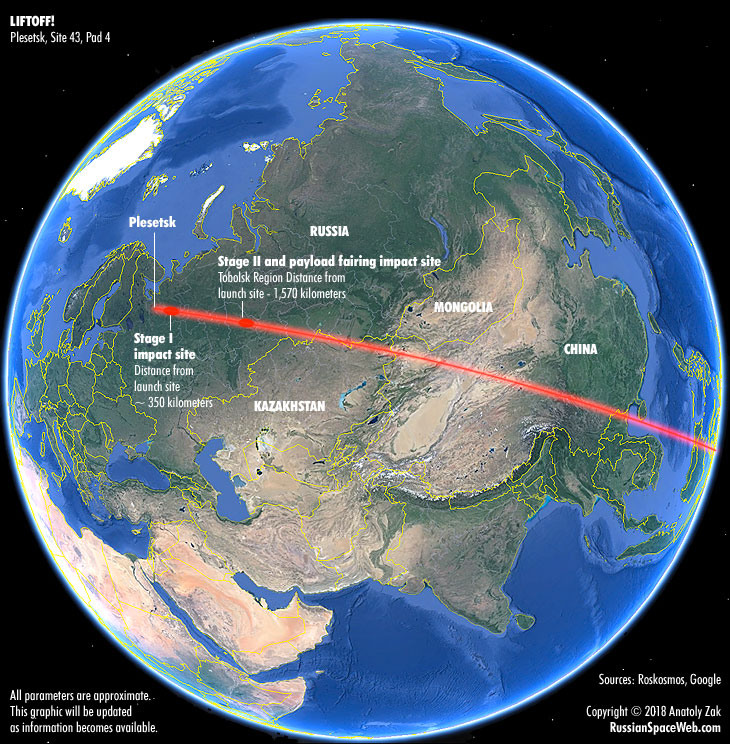
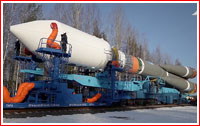
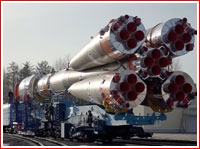
The liftoff of the Soyuz-2-1a rocket with a Fregat upper stage from Pad 3 at Site 43 in Plesetsk took place on April 3, 2026, at 09:28 Moscow Time (2:28 a.m. EDT). The vehicle likely carried the 11th satellite in the Meridian series and the third such spacecraft in the second production batch of satellites, known as Meridian-M, whose launches started in 2019. The routine flight profiles of the Meridian missions typically last around two hours and 15 minutes. Lifting off under the power of the first stage, the Soyuz-2 rocket heads southeast across the Russian territory to align its ground track with an orbit inclined 62.8 degrees toward the Equator. The four boosters of the first stage separate around two minutes into the flight. In the following six minutes, the second and third stages insert the Fregat upper stage and its payload into a ballistic trajectory, just short of orbital velocity. After parting with the third stage, the Fregat then fires its engine for 13 seconds to enter an initial parking orbit around 200 kilometers above the Earth's surface. Then, after an almost half-an-hour coasting flight, Fregat's engine ignites again to boost the apogee (highest point) of the orbit to an altitude of nearly 36,000 kilometers above the Earth's surface. Finally, the third firing lifts the perigee (the lowest point) of the orbit to around 885 kilometers, where the satellite is then released. Free from its cargo, the Fregat upper stage then fires its engine to enter a disposal orbit, safely away from its former passenger. Around 4.5 hours after the launch on April 3, 2026, the Russian Ministry of the Defense declared the launch a success and confirmed reliable communications with the newly launched military spacecraft. By April 4, the US Space Force cataloged two objects associated with the Meridian launch in the expected highly elliptical "Molniya-type" orbit:
|
|

|