In his public presentation to the Prime-Minister Mikhail Mishustin on Sept. 22, 2026, Head of Roskosmos Dmitry Bakanov reported that around 60 satellites had been launched since the beginning of the year and that the Russian orbital grouping had nearly reached 400 satellites, even though just 300 Russian satellites were reported to be operating a year earlier. In any case, these statistics likely included small educational and experimental cubesats, but also more than 30 newly launched satellites for the low-orbital Internet constellation (INSIDER CONTENT).
| 1 |
USA |
Jan. 2 |
6:09:16 p.m. Pacific Time |
Cosmo-SkyMed Gen. 2 (CSG-FM3) |
Military / remote sensing |
Falcon-9 |
Vandenberg |
SLC-4E |
E |
Success |
| 2 |
USA |
Jan. 3 |
1:48:10 a.m. EST |
Starlink-6-88 (29 satellites) |
Application / Internet |
Falcon-9 |
Cape Canaveral |
SLC-40 |
|
Success |
| 3 |
USA |
Jan. 9 |
4:41 p.m. EST |
Starlink-6-96 (29 satellites) |
Application / Internet |
Falcon-9 |
Cape Canaveral |
SLC-40 |
|
Success |
| 4 |
USA |
Jan. 11 |
5:44:50 a.m. Pacific Time |
Twilight mission: Pandora, SPARCS, BlackCAT, Kepler Tranche-1 (10 satellites) Minas/Lemur-2 (8 satellites) CarbSAR, Umbra-12 and others |
Science / astronomy |
Falcon-9 |
Vandenberg |
SLC-4E |
E |
Success |
| 5 |
India |
Jan. 12 |
10:18:30 India Standard Time |
EOS-N1 and 18 secondary payloads, including KID capsule |
Military / observation |
PSLV-DL (C62) |
Sriharikota |
FLP |
|
Failure |
| 6 |
USA |
Jan. 12 |
4:08:20 p.m. EST |
Starlink-6-97 (29 satellites) |
Application / Internet |
Falcon-9 |
Cape Canaveral |
SLC-40 |
|
Success |
| 7 |
China |
Jan 13 |
22:16 Beijing Time |
Yaogan-50-01 |
Military |
Chang Zheng-6A |
Taiyuan |
|
|
Success |
| 8 |
China |
Jan. 13 |
23:25:31 Beijing Time |
Guowang (Weixing Hulianwang Digui/SatNet LEO) Group 18 (9 satellites) |
Application / Internet |
Chang Zheng-8A |
Wenchang |
1 |
|
Success |
| 9 |
USA |
Jan. 14 |
1:08 p.m. EST |
Starlink-6-98 (29 satellites) |
Application / Internet |
Falcon-9 |
Cape Canaveral |
SLC-40 |
|
Success |
| 10 |
China |
Jan. 15 |
12:01 Beijing Time |
Alsat-3A |
Application / communications |
Chang Zheng-2C |
Jiuquan |
|
|
Success |
| 11 |
China |
Jan. 16 |
04:10 Beijing Time |
Tianqi-IoT-37, -38, -39, -40 (4 satellites) |
Application / Internet |
Gushenxing-1S Y7 (Ceres-1) |
Yellow Sea, Rizhao, Shandong Province |
Dongfeng Hangtiangang barge DEFU0001 |
|
Success |
| 12 |
China |
Jan. 17 |
00:55 Beijing Time |
SJ-32 |
|
Chang Zheng-3B |
Xichang |
|
|
Failure |
| 13 |
USA |
Jan. 16 |
8:40 p.m. Pacific Time |
NROL-105 (Starshield) |
Military |
Falcon-9 |
Vandenberg |
SLC-4E |
E |
Success |
| 14 |
China |
Jan. 17 |
12:08 Beijing Time |
? |
|
Gushenxing-2 |
Jiuquan |
|
|
Failure |
| 15 |
USA |
Jan. 18 |
6:31 p.m. EST |
Starlink-6-100 (29 satellites) |
Application / Internet |
Falcon-9 |
Cape Canaveral |
SLC-40 |
|
Success |
| 16 |
China |
Jan. 19 |
15:48 Beijing Time |
Guowang (Weixing Hulianwang Digui/SatNet LEO) Group 19 (9 satellites) |
Application / Internet |
Chang Zheng-12 (Y5) |
Wenchang |
2 |
|
Success |
| 17 |
USA |
Jan. 21 |
9:47 p.m. Pacific Time |
Starlink-17-30 (25 satellites) |
Application / Internet |
Falcon-9 |
Vandenberg |
SLC-4E |
E |
Success |
| 18 |
USA |
Jan. 22 |
11:52 p.m. New Zealand Time |
OpenCosmos (2 satellites) |
Application / communications |
Electron |
Mahia |
LC-1A |
A |
Success |
| 19 |
USA |
Jan. 25 |
9:30 a.m. Pacific Time |
Starlink-17-20 (25 satellites) |
Application / Internet |
Falcon-9 |
Vandenberg |
SLC-4E |
E |
Success |
| 20 |
USA |
Jan. 27 |
11:53 p.m. EST |
GPS-3-9 |
Military / navigation |
Falcon-9 |
Cape Canaveral |
SLC-40 |
|
Success |
| 21 |
USA |
Jan. 29 |
9:53:20 a.m. Pacific Time |
Starlink-17-19 (25 satellites) |
Application / Internet |
Falcon-9 |
Vandenberg |
SLC-4E |
E |
Success |
| 22 |
USA |
Jan. 30 |
1:55 p.m. New Zealand Time |
NeonSat-1A |
Application / remote sensing |
Electron |
Mahia |
LC-1 |
|
Success |
| 23 |
USA |
Jan. 30 |
2:22 a.m. EST |
Starlink-6-101 |
Application / Internet |
Falcon-9 |
Cape Canaveral |
|
|
Success |
| 24 |
China |
Jan. 31 |
12:01 Beijing Time |
AlSat-3B |
Imaging |
Chang Zheng-2C |
Jiuquan |
|
|
Success |
| 25 |
USA |
Feb. 2 |
7:47 a.m. Pacific Time |
Starlink-17-32 (25 satellites) |
Application / Internet |
Falcon-9 |
Vandenberg |
SLC-4E |
E |
Success* |
| 26 |
Russia (IC) |
Feb. 5 |
21:59 Moscow Time |
Kosmos |
Military |
Soyuz-2.1b/Fregat |
Plesetsk |
Site 43 |
4 |
Success |
| 27 |
China |
Feb. 7 |
11:57 Beijing Time |
Space plane (Mission 4) |
Military |
Chang Zheng-2F |
Jiuquan |
|
|
Success |
| 28 |
USA |
Feb. 7 |
12:41 p.m. Pacific Time |
Starlink-17-33 (25 satellites) |
Application / Internet |
Falcon-9 |
Vandenberg |
SLC-4E |
E |
Success |
| 29 |
USA |
Feb. 11 |
9:11 a.m. Pacific Time |
Starlink-17-34 (24 satellites) |
Application / Internet |
Falcon-9 |
Vandenberg |
SLC-4E |
E |
Success |
| 30 |
China |
Feb. 12 |
14:37 Beijing Time |
PRSC-EO2 (Bajisitan), Gangzhongda-1, Dianli Hongwai -A, Shuzi Yuxing-03, Shuzi Yuxing-04, Shuzi Yuxing-05, Kongjian Huanjing Jiance |
|
Jielong-3 (Y9) |
South-China Sea, Yangjiang, Guangdong Province |
Dongfeng Hangtiangang barge |
|
Success |
| 31 |
Russia (IC) |
Feb. 12 |
11:52:15 Moscow Time |
Elektro-L No. 5 |
Application (IC) / remote sensing |
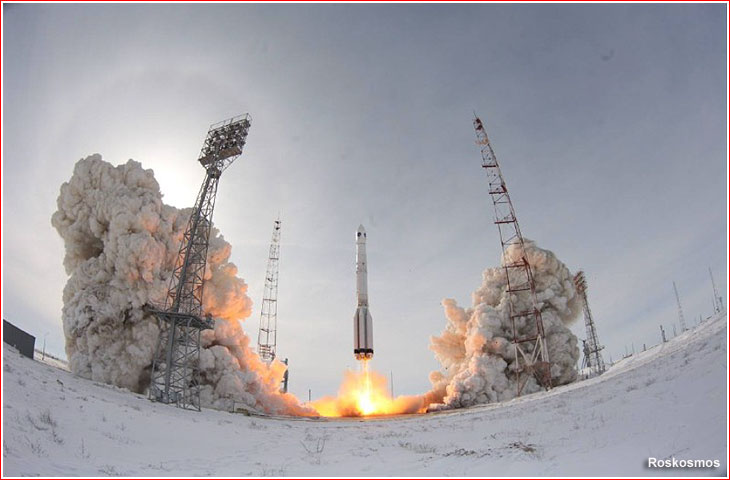
Proton-M/Block DM-03 |
Baikonur |
Site 81 |
24 |
Success |
| 32 |
USA |
Feb. 12 |
4:22 a.m. EST |
USSF-87 (GSSAP, ESPAStar) |
Military |
Vulcan VC4S |
Cape Canaveral |
SLC-41 |
|
Success** |
| 33 |
Europe |
Feb. 12 |
13:45 French Guiana Time |
Amazon Leo LE-01 (32 satellites) |
Application / Internet |
Ariane-6 (VA267) |
Kourou |
ELA-4 |
|
Success |
| 34 |
USA |
Feb. 13 |
5:15:55 a.m. EST |
Crew Dragon (USCV-12) |
Piloted |
Falcon-9 |
Cape Canaveral |
SLC-40 |
|
Success |
| 35 |
USA |
Feb. 14 |
6 p.m. Pacific Time |
Starlink17-13 (24 satellites) |
Application / Internet |
Falcon-9 |
Vandenberg |
SLC-4E |
E |
Success |
| 36 |
USA |
Feb. 16 |
2:59 a.m. EST |
Starlink-6-103 (29 satellites) |
Application / Internet |
Falcon-9 |
Cape Canaveral |
SLC-40 |
|
Success |
| 37 |
USA |
Feb. 19 |
8:41 p.m. EST |
Starlink-10-36 (29 satellites) |
Application / Internet |
Falcon-9 |
Cape Canaveral |
|
|
Success |
| 38 |
USA |
Feb. 21 |
1:04 a.m. Pacific Time |
Starlink-17-25 (25 satellites) |
Application / Internet |
Falcon-9 |
Vandenberg |
SLC-4E |
E |
Success |
| 39 |
USA |
Feb. 21 |
10:47 p.m. EST |
Starlink-6-104 (28 satellites) |
Applicaiton / Internet |
Falcon-9 |
Cape Canaveral |
SLC-40 |
|
Success |
| 40 |
USA |
Feb. 24 |
6:04 p.m. EST |
Starlink-6-110 (29 satellites) |
Application / Internet |
Falcon-9 |
Cape Canaveral |
SLC-40 |
|
Success |
| 41 |
USA |
Feb. 25 |
|
Starlink-17-26 |
Application / Internet |
Falcon-9 |
Vandenberg |
SLC-4E |
E |
Success |
| 42 |
USA |
Feb. 27 |
7:16 a.m. EST |
Starlink-6-108 (29 satellites) |
Application / Internet |
Falcon-9 |
Cape Canaveral |
SLC-40 |
|
Success |
| 43 |
USA |
March 1 |
2:10 a.m. Pacific Time |
Starlink-17-23 (25 satellites) |
Application / Internet |
Falcon-9 |
Vandenberg |
SLC-4E |
E |
Success |
| 44 |
USA |
March 1 |
9:56 p.m. EST |
Starlink-10-41 (29 satellites) |
Application / Internet |
Falcon-9 |
Cape Canaveral |
SLC-40 |
|
Success |
| 45 |
USA |
March 4 |
5:52 a.m. EST |
Starlink-10-40 (29 satellites) |
Application / Internet |
Falcon-9 |
Cape Canaveral |
SLC-40 |
|
Success |
| 46 |
Japan |
March 5 |
11:10:02 Japan Standard Time |
Tatara-1R, SC-Sat-1a, HErO, AETS-1, Nutsat-3 |
Experimental |
Kairos (No. 3) |
|
|
|
Failure |
| 47 |
USA |
March 6 |
12:53 New Zealand Time |
BlackSky Global Gen. 3 |
Application/ remote sensing |
Electron |
Mahia |
LC-1 |
|
Success |
| 48 |
USA |
March 8 |
4 a.m. Pacific Time |
Starlink-17-18 (25 satellites) |
Application / Internet |
Falcon-9 |
Vandenberg |
SLC-4E |
E |
Success |
| 49 |
USA |
March 10 |
12:19 a.m. EDT |
EchoStar-25 |
Application / communications |
Falcon-9 |
Cape Canaveral |
SLC-40 |
|
Success |
| 50 |
USA |
March 11 |
5:50 p.m. Pacific Time |
LM-400 |
Experimental |
FireFly Alpha (FLTA007) |
Vandenberg |
SLC-2W |
W |
Success |
| 51 |
China |
March 13 |
03:48 Beijing Time |
Guowang (Weixing Hulianwang Digui/SatNet LEO) Group 20 (9 satellites) |
Application / Internet |
Chang Zheng-8A |
Wenchang |
|
|
Success |
| 52 |
China |
March 13 |
06:33 Beijing Time |
Shiyan-30-03, -30-04 |
|
Chang Zheng-2D |
Xichang |
|
|
Success |
| 53 |
USA |
March 13 |
7:58 a.m. Pacific Time |
Starlink-17-31 (25 satellites) |
Application / Internet |
Falcon-9 |
Vandenberg |
SLC-4E |
E |
Success |
| 54 |
USA |
March 14 |
8:37 a.m. EDT |
Starlink-10-48 (29 satellites) |
Application / Internet |
Falcon-9 |
Cape Canaveral |
SLC-40 |
|
Success |
| 55 |
China |
March 15 |
21:22 Beijing Time |
Yaogan-50 (2) |
|
Chang Zheng-6A |
Taiyuan |
|
|
Success |
| 56 |
China |
March 16 |
12:12 Beijing Time |
Juntian-104A, Dongpo-11, Dongpo-12, Dongpo-16, Weitong-1-01, Xiguang-106, Yuxing-3-05, Yuxing-3-06 |
Application |
Kuaizhou-11 |
Jiuquan |
|
|
Success |
| 57 |
USA |
March 16 |
10:19 p.n. Pacific Time |
Starlink-17-24 (25 satellites) |
Application / Internet |
Falcon-9 |
Vandenberg |
SLC-4E |
E |
Success |
| 58 |
USA |
March 17 |
9:27 a.m. EDT |
Starlink-10-46 (29 satellites) |
Application / Internet |
Falcon-9 |
Cape Canaveral |
SLC-40 |
|
Success |
| 59 |
USA |
March 19 |
10:20 a.m. EDT |
Starlink-10-33 (29 satellites) |
Application / Internet |
Falcon-9 |
Cape Canaveral |
SLC-40 |
|
Success |
| 60 |
USA |
March 21 |
07:10 New Zealand Daylight Time |
StriX-6 |
Application / radar imaging |
Electron |
Mahia |
|
|
Success |
| 61 |
USA |
March 20 |
2:51 p.m. Pacific Time |
Starlink-17-15 (25 satellites) |
Application / Internet |
Falcon-9 |
Vandenberg |
SLC-4E |
E |
Success |
| 62 |
Russia (IC) |
March 22 |
14:59:51.292 Moscow Time |
Progress MS-33 |
ISS / Cargo supply |
Soyuz-2-1a |
Baikonur |
Site 31 |
6 |
Success |
| 63 |
USA |
March 22 |
11:46 a.m. EDT |
Starlink-10-62 (29 satellites) |
Application / Internet |
Falcon-9 |
Cape Canaveral |
SLC-40 |
|
Success |
| 64 |
China |
March 22 |
23:49 Beijing Time |
Weili Kongjian (CentiSpace) (10 satellites) |
Application / navigation |
Jielong-3 |
South-China Sea, Yangjiang, Guangdong Province |
Dongfeng Hangtiangang barge |
|
Success |
| 65 |
Russia (IC) |
March 24 |
20:24 Moscow Time |
MKA OBZP1, Rassvet-3-1 (16 satellites) |
Application / Internet |
Soyuz-2-1b |
Plesetsk |
Site 43 |
4 |
Success |
| 66 |
China |
March 26 |
06:51 Beijing Time |
Siwei Gaojing-2-05, -2-06 |
Application / remote-sensing / imaging |
Chang Zheng-2D |
Taiyuan |
|
|
Success |
| 67 |
USA |
March 26 |
4:03 p.m. Pacific Time |
Starlink-17-17 (25 satellites) |
Application / Internet |
Falcon-9 |
Vandenberg |
SLC-4E |
E |
Success |
| 68 |
China |
March 27 |
12:11 Beijing Time |
Shiyan-33 |
|
Chang Zheng-2C |
Jiuquan |
|
|
Success |
| 69 |
USA |
March 28 |
22:14 New Zealand Time |
Celeste-LEO-PNT-1, -2 |
Experimental |
Electron |
Mahia |
LC-1 |
|
Success |
| 70 |
China |
March 30 |
19:00 Beijing Time |
Sinchzhenchen-01, -02, Tyanshi-01 |
Experimental / cargo supply |
Lijian-2 (Kinetica-2) |
Jiuquan |
|
|
Success |
| 71 |
USA |
March 30 |
4:02 a.m. Pacific Time |
Transporter-16 (119 payloads) |
Application |
Falcon-9 |
Vandenberg |
SLC-4E |
E |
Success |
| 72 |
USA |
March 30 |
5:15 p.m. EDT |
Starlink-10-44 (29 satellites) |
Application / Internet |
Falcon-9 |
Cape Canaveral |
|
|
Success |
| 73 |
USA |
April 1 |
6:35 p.m. EDT |
Orion, Tacheles, SWC-1, K-RadCube, Atenea |
Piloted / cis-lunar |
SLS |
Cape Canaveral |
LC-39B |
B |
Success |
| 74 |
USA |
April 2 |
7:15 a.m. EDT |
Starlink-10-58 (29 satellites) |
Application / Internet |
Falcon-9 |
Cape Canaveral |
SLC-40 |
|
Success |
| 75 |
China |
April 3 |
12:17 Beijing Time |
|
|
Tianlong-3 |
Jiuquan |
|
|
Failure |
| 76 |
Russia (IC) |
April 3 |
09:28 Moscow Time |
Meridian No. 21L |
Military / communications |
Soyuz-2-1a/Fregat |
Plesetsk |
Site 43 |
3 |
Success |
| 77 |
USA |
April 4 |
1:46 a.m. EDT |
Amazon Leo LA-05 (29 satellites) |
Application / Internet |
Atlas-5 (551) |
Cape Canaveral |
SLC-41 |
|
Success |
| 78 |
USA |
April 6 |
7:50 p.m. Pacific Time |
Starlink-17-35 (25 satellites) |
Application / Internet |
Falcon-9 |
Vandenberg |
SLC-4E |
E |
Success |
| 79 |
China |
April 7 |
21:32 Beijing Time |
Qianfan (18 satellites) |
Application / Internet |
Chang Zheng-8 |
Wenchang |
|
|
Success |
| 80 |
USA |
April 7 |
4:33 a.m. Pacific Time |
STP-S29A (7 satellites) |
Military / Air Force / Experimental |
Minotaur-4 |
Vandenberg |
SLC-8 |
|
Success |
| 81 |
China |
April 9 |
03:38 Beijing Time |
Guowang (Weixing Hulianwang Digui/SatNet LEO) Group 21 (6 satellites) |
Application / Internet |
Chang Zheng-6A |
Taiyuan |
|
|
Success |
| 82 |
USA |
April 10 |
10:04:19 p.m. Pacific Time |
Starlink-17-21 (25 satellites) |
Application / Internet |
Falcon-9 |
Vandenberg |
SLC-4E |
E |
Success |
| 83 |
China |
April 11 |
19:32 Beijing Time |
Xingwang Siyan-08A, -O8B |
Application / Internet |
Jielong-3 (Kinetica-1) |
South-China Sea, Yangjiang, Guangdong Province |
Dongfeng Hangtiangang barge |
|
Success |
| 84 |
USA |
April 11 |
7:41 a.m. EDT |
Cygnus NG-24 (SS Steven R. Nagel) |
Space station / cargo supply |
Falcon-9 |
Cape Canaveral |
SLC-40 |
|
Success |
| 85 |
China |
April 14 |
12:03 Beijing Time |
Jilin-1 Gaofen-07-A02-A04, B02-04, C02-03 (8 satellites) |
Imaging |
Lijian-1 (Kinetica-1) |
Jiuquan |
|
|
Success |
| 86 |
USA |
April 14 |
5:33 a.m. EDT |
Starlink-10-24 (29 satellites) |
Application / Internet |
Falcon-9 |
Cape Canaveral |
|
|
Success |
| 87 |
USA |
April 14 |
9:29 p.m. Pacific Time |
Starlink-17-27 (25 satellites) |
Application / Internet |
Falcon-9 |
Vandenberg |
SLC-4E |
E |
Success |
| 88 |
Russia (IC) |
April 17 |
02:17 Moscow Time |
Kosmos (8 satellites) |
Military |
Soyuz-2.1b/Volga |
Plesetsk |
Site 43 |
4 |
Success |
| 89 |
China |
April 17 |
12:10 Beijing Time |
Daqi-2 |
Science / greenhouse gases |
Chang Zheng-4C |
Jiuquan |
|
|
Success |
| 90 |
USA |
April 19 |
7:25 a.m. EDT |
BlueBird-7 |
Application / communications |
New Glenn (F3) |
Cape Canaveral |
LC-36 |
|
Failure |
| 91 |
USA |
April 19 |
9:03 a.m. Pacific Time |
Starllink-17-22 (25 satellites) |
Application / Internet |
Falcon-9 |
Vandenberg |
SLC-4E |
E |
Success |
| 92 |
USA |
Apri 21 |
2:53 a.m. EDT |
GPS-3-SV10 |
Military / navigation |
Falcon-9 |
Cape Canaveral |
SLC-40 |
|
Success |
| 93 |
USA |
April 23 |
15:09 New Zealand Time |
(8 satellites) |
|
Electron |
Mahia |
|
|
Success |
| 94 |
USA |
April 22 |
8:23 p.m. Pacific Time |
Starlink-17-14 (25 satellites) |
Application / Internet |
Falcon-9 |
Vandenberg |
SLC-4E |
E |
Success |
| 95 |
Russia (IC) |
April 23 |
11:29 Moscow Time |
Kosmos |
Military |
Angara-1.2 |
Plesetsk |
Site 35 |
|
Success |
| 96 |
China |
April 24 |
14:35 Beijing Time |
Hulianwang Jishu Shiyan (4 satellites) |
Internet |
Chang Zheng-2D |
Xichang |
|
|
Success |
| 97 |
Russia (IC) |
April 26 |
01:21:47.460 Moscow Time |
Progress MS-34 |
Space station / cargo supply |
Soyuz-2-1a |
Baikonur |
Site 31 |
6 |
Success |
| 98 |
China |
April 26 |
20:15 Beijing Time |
PRSC-EO-3 |
Application / remote sensing |
Chang Zheng-6 |
Taiyuan |
|
|
Success |
| 99 |
USA |
April 26 |
7:37 a.m. Pacific Time |
Starlink (25 satellites) |
Application / Internet |
Falcon-9 |
Vandenberg |
SLC-4E |
E |
Success |
| 100 |
USA |
April 27 |
8:53:30 p.m. EDT |
Amazon Leo LA-06 (29 satellites) |
Application Internet |
Atlas-5 (551, AV-112) |
Cape Canaveral |
SLC-41 |
|
Success |
| 101 |
USA |
April 29 |
10:13 a.m. EDT |
ViaSat-3 F3 |
Applicaiton / communications |
Falcon Heavy |
Cape Canaveral /KSC |
LC-39 |
|
Success |
| 102 |
USA |
April 29 |
7:42:49 p.m. Pacific Time |
Starlink-17-36 (24 satellites) |
Application / Internet |
Falcon-9 |
Vandenberg |
SLC-4E |
E |
Success |
| 103 |
Europe |
April 30 |
05:57 French Guiana Time |
Amazon Leo LE-02 (Kuiper F11) (32 satellites) |
Application / Internet |
Ariane-6 (VA-268) |
Kourou |
ELA-3 |
|
Success |
| 104 |
Russia (IC) |
April 30 |
21:00 Moscow Time |
GMM |
Experimental |
Soyuz-5 |
Baikonur |
Site 45 |
|
Success*** |
| 105 |
USA |
May 1 |
2:06 p.m. EDT |
Starlink-10-38 (29 satellites) |
Application / Internet |
Falcon-9 |
Cape Canaveral |
SLC-40 |
|
Success |
| 106 |
USA |
May 2 |
11:59 p.m. Pacific Time |
CAS-500-2 and 44 secondary payloads |
Application / remote sensing |
Falcon-9 |
Vandenberg |
SLC-4E |
E |
Success |
| 107 |
USA |
May 5 |
8:59 p.m. Pacific Time |
Starlink-17-29 (24 satellites) |
Application / Internet |
Falcon-9 |
Vandenberg |
SLC-4E |
E |
Success |
| 108 |
China |
May 11 |
08:14:32 Beijing Time |
Tianzhou-10 |
Cargo supply |
Chang Zheng-7 |
Wenchang |
201 |
|
Success |
| 109 |
USA |
May 12 |
7:13 p.m. Pacific Time |
NROL-172 |
Military |
Falcon-9 |
Vandenberg |
SLC-4E |
E |
Success |
| 110 |
China |
May 12 |
19:58 Beijing Time |
Qianfan Jigui-08 (Thousand Sails) (18 satellites) |
Application / Internet |
Chang Zheng-6A |
Taiyuan |
|
|
Success |
| 111 |
China |
May 14 |
11:00 Beijing Time |
Dummy satellite |
Experimental |
Zhuque-2E (Y5) |
Jiuquan |
|
|
Failure**** |
| 112 |
China |
May 15 |
12:33 Beijing Time |
Youxi, Dianjian-1, JL1GF03D55, Taijing-3-05A, -05B |
|
Lijian-1 |
Jiuquan |
|
|
Success |
| 113 |
USA |
May 15 |
6:05 p.m. EDT |
Cargo Dragon CRS-34 |
Cargo supply |
Falcon-9 |
Cape Canaveral |
SLC-40 |
|
Success |
| 114 |
China |
May 17 |
22:43 Beijing Time |
Qianfan Jigui-09 (Thousand Sails) (18 satellites) |
Application / Internet |
Chang Zheng-8 |
Wenchang |
|
|
Success |
| 115 |
Europe |
May 19 |
00:52 French Guiana Time |
SMILE |
Science / Geophysics |
Vega-C |
Kourou |
ELA-1 |
|
Success |
| 116 |
USA |
May 19 |
7:46:19 p.m. Pacific Time |
Starlink-17-42 (24 satellites) |
Application / Internet |
Falcon-9 |
Vandenberg |
SLC-4E |
E |
Success |
| 117 |
USA |
May 21 |
6:04 a.m. EDT |
Starlink-10-31 (29 satellites) |
Application / Internet |
Falcon-9 |
Cape Canaveral |
SLC-40 |
|
Success |
| 118 |
USA |
May 22 |
09:34 UTC |
StriX-7 |
Application / remote sensing |
Electron |
Mahia |
LC-1B |
B |
Success |
| 119 |
USA |
May 22 |
5:30:20 p.m. Central Time |
Starship v3, No. 39 (Flight 12) |
Experimental |
Starship/Superheavy |
Boca Chica |
|
|
Success***** |
| 120 |
China |
May 24 |
23:08 Beijing Time |
Shenzhou-23 |
Piloted / space station |
Chang Zheng-2F |
Jiuquan |
|
|
Success |
| 121 |
USA |
May 25 |
7:48 a.m. EDT |
Starlink-10-47 (29 satellites) |
Application / Internet |
Falcon-9 |
Cape Canaveral |
SLC-40 |
|
Success |
| 122 |
USA |
May 26 |
7:50 a.m. Pacific Time |
Starlink-10-37 |
Application / Internet |
Falcon-9 |
Vandenberg |
SLC-4E |
E |
Success |
| 123 |
China |
May 27 |
00:16 Beijing Time |
TJSW-24 |
|
Chang Zheng-7A |
Wenchang |
201 |
|
Success |
| 124 |
USA |
May 29 |
8:57 a.m. EDT |
Starlink-10-53 |
Application / Internet |
Falcon-9 |
Cape Canaveral |
SLC-40 |
|
Success |
| 125 |
USA |
May 29 |
7:53 p.m. EDT |
Amazon Leo LA-07 (29 satellites) |
Application / Internet |
Atlas-5 (551, AV-113) |
Cape Canaveral |
SLC-41 |
|
Success |
| 126 |
USA |
May 30 |
8:25 a.m. Pacific Time |
Starlink-17-41 (24 satellites) |
Application / Internet |
Falcon-9 |
Vandenberg |
SLC-4E |
E |
Success |
| 127 |
China |
May 31 |
02:07 Beijing Time |
GuoWang (4 satellites) |
Application / Internet |
Chang Zheng-2D |
Xichang |
|
3 |
Success |
| 128 |
China |
June 1 |
16:40 Beijing Time |
Qianfan Jigui-10 (18 satellites?) |
Application / Internet |
Chang Zheng-12B (Y1) |
Jiuquan |
|
|
Success |
| 129 |
USA |
June 3 |
8:40 a.m. Pacific Time |
Starlink-17-47 (24 satellites) |
Application / Internet |
Falcon-9 |
Vandenberg |
SLC-4E |
E |
Success |
| 130 |
USA |
June 4 |
6:26 a.m. EDT |
Starlink-10-43 |
Application / Internet |
Falcon-9 |
Cape Canaveral |
SLC-40 |
|
Success |
| 131 |
China |
June 4 |
19:41 Beijing Time |
Qianfan Jigui-11 (2 satellites) |
Application / Internet |
Chang Zheng-6A |
Taiyuan |
|
|
Success |
| 132 |
China |
June 5 |
14:34 Beijing Time |
Qianfan Jigui-12 |
Application / Internet |
Chang Zheng-8 |
Wenchang |
|
|
Success |
| 133 |
USA |
June 6 |
9:24 p.m. Pacific Time |
Starlink-17-43 (21 satellite), Starshield (2 satellites) |
Application / Internet |
Falcon-9 |
Vandenberg |
SLC-4E |
E |
Success |
| 134 |
USA |
June 8 |
6:14 a.m. EDT |
Starlink-10-35 (29 satellites) |
Application / Internet |
Falcon-9 |
Cape Canaveral |
SLC-40 |
|
Success |
| 135 |
China |
June 9 |
16:23 Beijing Time |
Qianfan Direct-to-Cell-01 (DTC-01), China Mobile-02 |
Application / communications |
Zhuque-2E |
Jiuquan |
|
|
Success |
| 136 |
China |
June 11 |
15:30 Beijing Time |
Tongxin Jishu Shiyan Weixing, TJW-25 |
Communications |
Chang Zheng-5 |
Wenchang |
|
|
Success |
| 137 |
USA |
June 11 |
8:05 a.m. Pacific Time |
Starlink-17-44 (24 satellites) |
Application / Internet |
Falcon-9 |
Vandenberg |
SLC-4E |
E |
Success |
| 138 |
Japan |
June 12 |
09:53 Japan Standard Time |
VEP-5 mass simulator, STAR-X, BRO-22, VERTECS, PETREL, HORN-L, HORN-R |
Experimental |
H3-30S (Flight 6) |
Tanegashima |
|
|
Success |
| 139 |
USA |
June 12 |
8:37 a.m. EDT |
Starlink-10-54 (29 satellites) |
Application / Internet |
Falcon-9 |
Cape Canaveral |
SLC-40 |
|
Success |
| 140 |
China |
June 15 |
11:44 Beijing Time |
Changguang Jilin-1 (8 satellites) |
Remote sensing |
Lijian-1 (Kinetica-1) |
Jiuquan |
130 |
|
Success |
| 141 |
USA |
June 15 |
8:34 a.m. Pacific Time |
Starlink-17-54 (24 satellites) |
Application / Internet |
Falcon-9 |
Vandenberg |
SLC-4E |
E |
Success |
| 142 |
China |
June 16 |
17:45 Beijing Time |
Shijian-31 |
|
Chang Zheng-3B |
Xichang |
|
|
Success |
| 143 |
China |
June 17 |
10:44 Beijing Time |
Xingwang Digui (SatNet LEO-22) |
Application / Internet |
Chang Zheng-12 |
Wenchang |
|
|
Success |
| 144 |
USA |
June 17 |
02:39 a.m. EDT |
AST Space Mobile BlueBird-8, -9, -10 |
Communications |
Falcon-9 |
Cape Canaveral |
SLC-40 |
|
Success |
| 145 |
China |
June 17 |
11:58 Beijing Time |
Weili Kongjian-05 (7 satellites) |
|
Kuaizhou-11 |
Jiuquan |
|
|
Success |
| 146 |
Europe |
June 17 |
9:21:52 a.m. French Guiana Time |
Amazon-LEO -03 (36 satellites) |
Application / Internet |
Ariane-6 (VA-269) |
Kourou |
ELA-4 |
|
Success |
| 147 |
USA |
June 19 |
1:50 a.m. Pacific Time |
NROL-179 Starshield |
Military |
Falcon-9 |
Vandenberg |
SLC-4E |
E |
Success |
| 148 |
USA |
June 20 |
22:19 New Zealand Time |
Victus Haze Puma |
Military |
Electron |
Mahia |
LC-1 |
|
Success |
| 149 |
USA |
June 21 |
9:39 a.m. Pacific Time |
Starlink-17-28 (24 satellites) |
Application / Internet |
Falcon-9 |
Vandenberg |
SLC-4E |
E |
Success |
| 150 |
China |
June 23 |
10:10 Beijing Time |
TJSW-26A |
Communications |
Chang Zheng-7A |
Wenchang |
|
|
Success |
| 151 |
USA |
June 23 |
6:53 a.m. EDT |
Starfall Demo |
Experimental / reentry |
Falcon-9 |
Cape Canaveral |
SLC-40 |
|
Success |
| 152 |
USA |
June 24 |
8:31 p.m. Pacific Time |
Starlink-17-45 (24 satellites) |
Application / Internet |
Falcon-9 |
Vandenberg |
SLC-4E |
E |
Success |
| 153 |
USA |
June 27 |
05:23 New Zealand Standard Time |
Synspective StriX-8 |
Application / Remote-sensing |
Electron |
Mahia |
LC-1B |
B |
Success |
| 154 |
USA |
June 28 |
9:09 a.m. Pacific Time |
Starlink-17-40 (24 satellites) |
Application / Internet |
Falcon-9 |
Vandenberg |
SLC-4E |
E |
Success |
| 155 |
USA |
June 28 |
10:25 p.m. EDT |
SiriusXM SXM-11 |
Application / radio broadcasting |
Falcon-9 |
Cape Canaveral |
SLC-40 |
|
Success |
| 156 |
China |
July 2 |
07:46 Beijing Time |
Haiyang-2-05 |
Science / oceanography |
Chang Zheng-4B |
Jiuquan |
|
|
Success |
| 157 |
USA |
July 1 |
7:58 p.m. Pacific Time |
Starlink-17-46 (24 satellites) |
Application / Internet |
Falcon-9 |
Vandenberg |
SLC-4E |
E |
Success |
| 158 |
USA |
July 2 |
12:30 a.m. EDT |
Amazon-LEO-LA08 (29 satellites) |
Application / Internet |
Atlas-5-551 (AV-114) |
Cape Canaveral |
SLC-41 |
|
Success |
| 159 |
USA |
July 3 |
08:36 UTC |
LINK (SWIFT reboost mission) |
Application / orbital reboost |
Pegasus-XL |
Kwajalein |
L-1011 Stargazer |
|
Success |
| 160 |
China |
July 4 |
17:30 p.m. Beijing Time |
Qianfan Jigui-13 |
Application / Internet |
Chang Zheng-6A |
Taiyuan |
|
|
Success |
| 161 |
USA |
July 5 |
6:50 a.m. EDT |
Starlink-10-50 |
Application / Internet |
Falcon-9 |
Cape Canaveral |
|
|
Success |
| 162 |
China |
July 5 |
21:43 Beijing Time |
Qianfan Jigui-15 (20 satellites) |
Application / Internet |
Chang Zheng-8A |
Wenchang |
|
|
Success |
| 163 |
USA |
July 7 |
0:12 a.m. Pacific Time |
Transporter-17 (81 payloads) |
Application |
Falcon-9 |
Vandenberg |
|
|
Success |
| 164 |
USA |
July 9 |
5:25 a.m. EDT |
Starlink-10-42 (29 satellites) |
Application / Internet |
Falcon-9 |
Cape Canaveral |
SLC-40 |
|
Success |
| 165 |
China |
July 10 |
12:15:57 Beijing Time |
Demo |
Experimental |
Chang Zheng-10B |
Wenchang |
|
|
Success |
| 166 |
USA |
July 10 |
8:01 p.m. Pacific Time |
Starlink-17-48 (24 satellites) |
Application / Internet |
Falcon-9 |
Vandenberg |
SLC-4E |
E |
Success |
| 167 |
USA |
July 13 |
6:28 p.m. Pacific Time |
Starlink-15-14 (27 satellites) |
Application / Internet |
Falcon-9 |
Vandenberg |
SLC-4E |
E |
Success |
| 168 |
USA |
July 14 |
5:10 a.m. EDT |
Starlink-10-45 (29 satellites) |
Application / Internet |
Falcon-9 |
Cape Canaveral |
SLC-40 |
|
Success |
| 169 |
Russia (IC) |
July 14 |
17:47:43:552 Moscow Time |
Soyuz MS-29 |
Piloted |
Soyuz-2-1a |
Baikonur |
Site 31 |
Pad 6 |
Success |
| 170 |
USA |
July 16 |
1:32 p.m. Pacific Time |
Tranche-1-3 (T1TL-E) |
Military / communications |
Falcon-9 |
Vandenberg |
SLC-4E |
E |
Success |
| 171 |
India |
July 18 |
|
2 cubesats |
Experimental |
Vikram-1 |
Sriharikota |
|
|
Success |
| 172 |
Russia (IC) |
July 19 |
20:51 Moscow Time |
Buro-1440 (multiple satellites) |
Application / communications (INSIDER CONTENT) |
Soyuz-2 |
Plesetsk |
Site 43 |
4 |
Success |
| 173 |
USA |
July 20 |
7:49 a.m. Pacific Time |
Starlink-17-39 (24 satellites) |
Application / Internet |
Falcon-9 |
Vandenberg |
SLC-4E |
E |
Success |
| 174 |
USA |
July 21 |
5:15 p.m. EDT |
MRV-MEP |
Application / in-orbit servicing |
Falcon-9 |
Cape Canaveral |
SLC-40 |
|
Success |
| 175 |
China |
July 22 |
10:54 Beijing Time |
Dongpo No. 13, -14, -17, -18, -19, -20, Xiguang-2-01, Tianyi-49, Zidingxiang-3 (9 satellites) |
Remote sensing |
Yinli-1 (Gravity-1) |
East-China Sea |
Dongfeng Hangtiangang barge |
|
Success |
| 176 |
China |
July 23 |
20:00 Beijing Time |
Tianlian-2-06 |
Communications / data relay |
Chang Zheng-3B |
Xichang |
|
|
Success |
| 177 |
China |
July 24 |
07:33 Beijing Time |
Tianyi-48, Gande-1-01, Xiguang-2-03, Jitianxing-A04, Yinglong Fengguang-1 |
Meteorology, space debris monitoring , remote-sensing, experimental |
Lijian-2 (Kinetica-2) |
Jiuquan |
130 |
|
Success |
| 178 |
USA |
July 24 |
5:51 p.m. Central Time |
Starship/ Starlinks*** |
Experimental |
Starship/Superheavy |
Boca Chica |
|
|
Success****** |
| 179 |
USA |
July 25 |
8:51 a.m. Pacific Time |
Starlink-17-51 (24 satellites) |
Application / Internet |
Falcon-9 |
Vandenberg |
SLC-4E |
E |
Success |
| 180 |
China |
July 29 |
19:50 Beijing Time |
Tianlian-3-01 |
Communications / data relay |
Chang Zheng-7A (Y29) |
Wenchang |
201 |
|
Success |
| 181 |
China |
July 30 |
09:00 Beijing Time |
Tongxin Jishu Shiyan (TJSW-27A, -27B) (2 satellites) |
Military |
Chang Zheng-6A |
Taiyuan |
|
|
Success |
| 182 |
USA |
July 30 |
3:10 a.m. EDT |
NROL-95 (USA-619 Intruder) |
Military / SIGINT |
Falcon-9 |
Cape Canaveral |
SLC-40 |
|
Success |
| 183 |
USA |
July 31 |
8:08 p.m. Pacific Time |
Starlink-17-52 (24 satellites) |
Applications / Internet |
Falcon-9 |
Vandenberg |
SLC-4E |
E |
Success |
| 184 |
China |
Aug. 4 |
16:52 Beijing Time |
Xingwang Digui (SatNet LEO-23) |
Applications / Internet |
Chang Zheng-8A |
Wenchang |
|
|
Success |
| 185 |
USA |
Aug. 4 |
11:05 a.m. Pacific Time |
Starlink-17-53 (24 satellites) |
Application / Internet |
Falcon-9 |
Vandenberg |
SLC-4E |
E |
Success |
| 186 |
China |
Aug. 5 |
15:49 Beijing Time |
Dongfang Huiyan Hyperspectral -01, 02 |
Application / remote sensing |
Jielong-3 |
South-China Sea, Yangjiang, Guangdong Province |
Dongfeng Hangtiangang barge |
|
Success |
| 187 |
USA |
Aug. 5 |
3:49 a.m. EDT |
BlueBird-11, -12, -13 |
Application / communications |
Falcon-9 |
Cape Canaveral |
SLC-40 |
|
Success |
| 188 |
USA |
Aug. 6 |
09:18 UTC |
QPS-SAR-13 |
Application / remote sensing |
Electron |
Mahia |
LC-1A |
A |
Success |
| 189 |
USA |
Aug. 8 |
9:35 a.m. Pacific Time |
Starlink-17-38 (24 satellites) |
Application / Internet |
Falcon-9 |
Vandenberg |
SLC-4E |
E |
Success |
| 190 |
China |
Aug. 10 |
20:02 Beijing Time |
ZX-4B |
Military / communications |
Chang Zheng-7A |
Wenchang |
|
|
Failure |
| 191 |
Japan |
Aug 11 |
04:23 Japan Standard Time |
QZS Michibiki-7 |
Application / navigation |
H3 |
Tanegashima |
|
|
Success |
| 192 |
USA |
Aug. 11 |
11:58:26 a.m. EDT |
Starlink-10-19 (29 satellites) |
Application / Internet |
Falcon-9 |
Cape Canaveral |
SLC-40 |
|
Success |
| 193 |
USA |
Aug. 11 |
9:46 p.m. Pacific Time |
Starlink-17-49 (24 satellites) |
Application / Internet |
Falcon-9 |
Vandenberg |
SLC-4E |
E |
Success |
| 194 |
USA |
Aug. 15 |
9:12 p.m. EDT |
Globalstart-2R-1 (9 satellites) |
Application / communications |
Falcon-9 |
Cape Canaveral |
SLC-40 |
|
Success |
| 195 |
USA |
Aug. 15 |
6:50 p.m. Pacific Ocean |
USSF-366 |
Military |
Falcon-9 |
Vandenberg |
SLC-4E |
E |
Success |
| 196 |
China |
Aug. 16 |
12:10 Beijing Time |
Xingwang Digui (SatNet LEO-24) |
Application / Internet |
Chang Zheng-12 |
Wenchang |
|
|
Success |
| 197 |
China |
Aug. 17 |
11:02 Beijing Time |
SEO |
Application / remote sensing |
Chang Zheng-2C |
Taiyuan |
|
|
Success |
| 198 |
China |
Aug. 19 |
07:35 Beijing Time |
Honghu-03 |
|
Zhuque-3 |
Jiuquan |
|
|
Success |
| 199 |
USA |
Aug. 18 |
9:01:07 p.m. Pacific Time |
Starlink-17-50 (24 satellites) |
Application / Internet |
Falcon-9 |
Vandenberg |
SLC-4E |
E |
Success |
| 200 |
USA |
Aug. 20 |
1:04 a.m. New Zealand Time |
QPS-SAR |
Application / remote sensing |
Electron |
Mahia |
LC-1B |
B |
Success |
| 201 |
USA |
Aug. 21 |
11:14 a.m. EDT |
Starlink-10-39 (29 satellites) |
Application / Internet |
Falcon-9 |
Cape Canaveral |
SLC-40 |
|
Success |
| 202 |
USA |
Aug. 22 |
12:25 a.m. Pacific Time |
Starlink-15-20 (27 satellites) |
Application / Internet |
Falcon-9 |
Vandenberg |
SLC-4E |
E |
Success |
| 203 |
Russia (IC) |
Aug. 24 |
05:40 Moscow Time |
Kosmos (GLONASS) |
Military |
Soyuz-2-1b |
Plesetsk |
Site 43 |
3 |
Success |
| 204 |
USA |
Aug. 25 |
5:33 a.m. EDT |
Starlink-10-49 (29 satellites) |
Application / Internet |
Falcon-9 |
Cape Canaveral |
SLC-40 |
|
Success |
| 205 |
China |
Aug. 25 |
11:21 Beijing Time |
ZK-14, -15, JAMX01, Bayi-04, GISTDA cubesat, Muduo-1A, -1B |
Remote sensing / radar imaging |
Chang Zheng-6C |
Taiyuan |
|
|
Success |
| 206 |
USA |
Aug. 26 |
2:36 a.m. Pacific Time |
Starlink-15-22 (27 satellites) |
Application / Internet |
Falcon-9 |
Vandenberg |
SLC-4E |
E |
Success |
| 207 |
Europe |
Aug. 27 |
17:10 French Guiana Time |
MTG-I2 |
Application / meteorology |
Ariane-6 (62, VA270) |
Kourou |
ELA-4 |
|
Success |
| 208 |
USA |
Aug. 30 |
7:26 a.m. EDT |
Nancy Grace Roman Space Telescope |
Science / astronomy |
Falcon Heavy |
Cape Canaveral / KSC |
LC-39A |
A |
Success |
| 209 |
China |
Sept. 1 |
10:00 Beijing Time |
Dummy cargo |
Experimental |
Zhishenxing-1 (Pallas-1) |
Jiuquan |
|
|
Failure |
| 210 |
USA |
Sept. 2 |
01:42:12 a.m. Pacific Time |
Starlink-15-23 (27 satellites) |
Application / Internet |
Falcon-9 |
Vandenberg |
SLC-4E |
E |
Success |
| 211 |
USA |
Sept. 3 |
00:01 a.m. New Zealand Time |
Synspective StriX-9 |
Application / remote sensing |
Electron |
Mahia |
LC-1B |
B |
Success |
| 212 |
India |
Sept. 4 |
02:55 India Standard Time |
EOS-05 |
Application / remote sensing |
GSLV-F17 |
Sriharikota |
|
|
Success |
| 213 |
Europe |
Sept. 5 |
20:12 UTC |
Multiple cubesats |
Experimental |
Spectrum |
Andoya |
|
|
Success |
| 214 |
USA |
Sept. 6 |
14:26 UTC |
Starlink-15-24 (27 satellites) |
Application / Internet |
Falcon-9 |
Vandenberg |
SLC-4E |
E |
Success |
| 215 |
China |
Sept. 10 |
17:00 Beijing Time |
Yaogan-53 (3 satellites), Yaogan-56 (3 satellites) |
Military |
Chang Zheng-4B |
Jiuquan |
|
|
Success |
| 216 |
USA |
Sept. 10 |
8:43 a.m. Pacific Time |
USSF-153 (23 satellites, USA-644 - 666 (Starshield?), R-2 test sat |
Military |
Falcon-9 |
Vandenberg |
SLC-4E |
E |
Success |
| 217 |
USA |
Sept. 11 |
03:28 UTC |
BlackSky Global-36 (Gen 3 No. 5) |
|
Electron |
Mahia |
|
|
Success |
| 218 |
USA |
Sept. 13 |
2:49 p.m. EDT |
O3b mPower-11, -12, -13 |
Application / Internet |
Falcon-9 |
Cape Canaveral |
SLC-40 |
|
Success |
| 219 |
Europe |
Sept. 14 |
22:21 French Guiana Time |
Sentinel-3C, FLEX |
Application / remote sensing |
Vega-C |
Kourou |
ELA-1 |
|
Success |
| 220 |
China |
Sept. 15 |
14:26 Beijing Time |
Qianfan (10 satellites) |
Application / Internet |
Zhuque-2E |
Jiuquan |
|
|
Success |
| 221 |
China |
Sept. 16 |
06:00 Beijing Time |
Qianfan Digui-26 (9 satellites), EUHT Jishu Shiyan Weixing |
Application / Internet |
Yinli-1 |
East China Sea |
Dongfeng Hangtiangang(DFHT) barge |
|
Success |
| 222 |
Russia (IC) |
Sept. 16 |
16:33:54.560 Moscow Time |
Progress MS-35 |
ISS / Cargo supply |
Soyuz-2-1b |
Baikonur |
Site 31 |
6 |
Success |
| 223 |
USA |
Sept. 16 |
6:29 p.m. Pacific Time |
USSF-259 (SBS TH-1), Starshield |
Military |
Falcon-9 |
Vandenberg |
SLC-4E |
E |
Success |
| 224 |
China |
Sept. 17 |
08:32 Beijing Time |
Xingwang Digui (SatNet LEO) Group 25 (9 satellites) |
Application / Internet |
Chang Zheng-12 |
Wenchang |
2 |
|
Success |
| 225 |
China |
Sept. 17 |
10:40 Beijing Time |
Tianyi-51, -52 |
Application / C-band SAR |
Kuaizhou-11 |
Jiuquan |
43/95A |
|
Success |
| 226 |
Russia (IC) |
Sept. 17 |
~19:50 Moscow Time |
Kosmos (GLONASS-K/K-2) |
Military / navigation |
Soyuz-2-1b/Fregat |
Plesetsk |
Site 43 |
3 |
Success |
| 227 |
USA |
Sept. 19 |
15:22 New Zealand Time |
StriX-10 |
Application / remote-sensing |
Electron |
Mahia |
LC-1B |
B |
Success |
| 228 |
China |
Sept. 19 |
18:50 Beijing Time |
Hongtu-02-13, -14, -15, -16 (PieSat) |
Application / SAR |
Chang Zheng-2D |
Taiyuan |
|
|
Success |
| 229 |
USA |
Sept. 19 |
6:47:00 p.m. Pacific Time |
Starlink-15-27 (27 satellites) |
Application / Internet |
Falcon-9 |
Vandenberg |
SLC-4E |
E |
Success |
| 230 |
China |
Sept. 20 |
12:03 Beijing Time |
Chaozhisuan-1 (Super-Intelligent Computing-1), PEGA-SUS1, Pujiang-4, Qinling-01, -02, Diting-1A, -1B, -1C, Yunxiao Pathfinder Satellite |
Application / communications / remote sensing |
Lijian-1 (Kinetica-1) |
Jiuquan |
130 |
|
Success |
| 231 |
China |
Sept. 23 |
21:32 Beijing Time |
Xingwang Digui (SatNet LEO) Group 26 |
Application / Internet |
Chang Zheng-8A |
Wenchang |
|
|
Success |
| 232 |
China |
Sept. 24 |
16:46 Beijing Time |
Yaogan-40 Group-04 -A, -B, -C |
Military / SIGINT |
Chang Zheng-6A |
Taiyuan |
|
|
Success |
| 233 |
USA |
Sept. 26 |
12:39 New Zealand Time |
StriX-13 |
Application / remote-sensing |
Electron |
Mahia |
LC-1B |
B |
Success |
| 234 |
USA |
Sept. 26 |
7:06 a.m. Pacific Time |
USSF-385 |
Military |
Falcon-9 |
Vandenberg |
SLC-4E |
E |
Success |
| 235 |
USA |
Sept. 28 |
7:48 a.m. Central Time |
Starlink V3 (26 satellites) |
Application / Internet |
Starship/Superheavy |
Boca Chica |
|
|
Success |
| 236 |
USA |
Oct. 1 |
11:10 a.m. EDT |
Crew Dragon Grace |
Crew / space station |
Falcon-9 |
Cape Canaveral |
SLC-40 |
|
Success |
| 237 |
USA |
Oct. 1 |
11:32 a.m. Pacific Time |
Transporter-18 (103 payloads) |
Application |
Falcon-9 |
Vandenberg |
SLC-4E |
E |
Success |
| 238 |
USA |
Oct. 1 |
11:54 p.m. EDT |
NROL-97 |
Military / reconnaissance |
Falcon Heavy |
Cape Canaveral/KSC |
LC-39A |
A |
In progress |
A Fregat upper stage, likely assigned to this mission, was reported to be delivered to Vostochny airport on July 10, 2026. It marked the first landing of the An-124-100 Ruslan transport aircraft at the new runway of the space center.
On July 22, 2026, Roskosmos announced the arrival of a train at Vostochny with the components of a Soyuz-2 rocket and its payload fairing likely intended for this mission. On Sept. 22, 2026, Roskosmos head Dmitry Bakanov, likely referring to MKA Kinosputnik (INSIDER CONTENT) and KOEN projects, reported to Prime Minister Mikhail Mishustin that two "private" satellites for optical electronic observation had already been delivered to Vostochny for a planned launch in the following month.
A Soyuz-2 vehicle for the mission was delivered to Baikonur by June 2, 2026, followed by the cargo ship itself on June 10, 2026.