|
|
|
|
|||||||||
Mir space station In February 1986, the USSR launched the first element of the modular space station. It was announced as Mir, meaning "world" and "peace" in Russian. The station, which eventually grew to seven modules and a mass of around 140 tons, outlived the Soviet Union and operated until March 2001, hosting 104 people from 12 countries. A total of 78 spacewalks were staged from the complex.
|
 |
||||||||
| 15 SPECTACULAR YEARS: 1986 - 2001 | |||||||||
 |
15 SPECTACULAR YEARS: The highlights of missions to Mir During its 15 years in orbit, Mir became a chapter in the history of space exploration. This section looks back at a few remarkable milestones in the station biography. |
||||||||
| MIR CLOSE CALLS | |||||||||
 |
A PERILOUS JOURNEY: Dangerous situations during missions to Mir Although Mir allowed almost permanent human presence in space and space flight itself seem routine, not once Russian cosmonauts and their guests were risking their lives in the situations which nobody had experienced before. |
||||||||
|
MIR
MODULES |
|||||||||
|
|
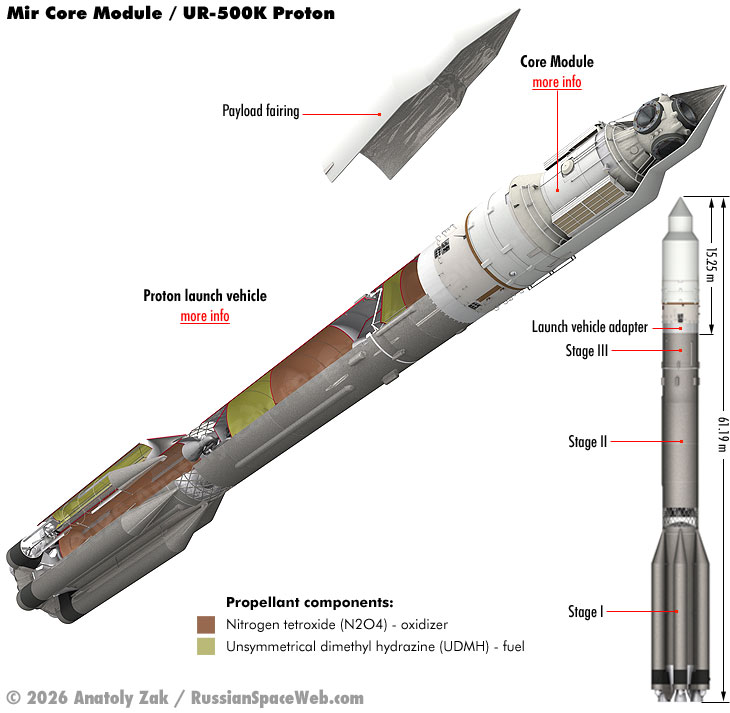
Core Module: Birth of a colony On Feb. 20, 1986, the Proton booster launched the core module of the Mir space station. The official Soviet news reports released immediately after the launch said that the spacecraft is equipped with six docking ports and will serve as core of the future multi-modular orbital station. |
||||||||
|
|
Kvant-1: Something old, something new Originally designed for the Salyut-7, the Mir predecessor, the Kvant module stuck on the ground until the new station is ready. The the oldest Mir's module was carrying the first set of gyrodines, a complex mechanical wheels, which for the first time allowing Soviet orbital station to maintain its attitude in space without firing its thrusters and consuming precious propellant. Kvant-1 also brought a deployable solar panel, which would be installed on the station's exterior. |
||||||||
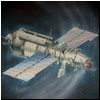 |
Kvant-2, launched in 1989, was the first of the four Mir modules based on a TKS transport spacecraft. The TKS was developed in the 1970s for the Almaz military orbital station. After the Almaz program had been abandoned in 1981, KB Salyut, the TKS developer, convinced the Soviet leadership to use the hardware from Almaz program for yet-to-be-launched Salyut-7 and Mir space stations. |
||||||||
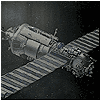 |
The Kristall Module was designed to carry furnaces and other payloads for experiments onboard Mir. The module was also equipped by a transfer compartment with a so-called androgynous docking port, which would allow reusable shuttle Buran to dock with the station. Although this mission has never taken place, the US Shuttle used this docking port to visit the station. |
||||||||
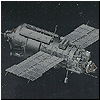 |
Spektr: From swords to plough shares Originally designed for military experiments, the Spektr remained grounded years after its original launch date due to financial problems in the former Soviet Union. The help came from NASA, which paid for the "reorientation" of the module to the scientific research in orbit. |
||||||||
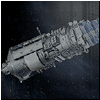 |
Priroda: Mission to Planet Earth Priroda (Nature) conceived for remote-sensing research from orbit, was also sitting on the ground partially completed until Russian-US cooperation revived the project. It became the last element, which completed the construction of Mir. |
||||||||
|
|
Docking Compartment: From Shuttle to Mir In its second mission to Mir in 1995, the US Shuttle delivered Russian-built docking compartment, which was attached to the Buran's docking port on the Kristall module. The docking compartment provided clearance between Shuttle and solar panels on Mir during docking. Without it, Kristall would have to be relocated to the core's module front docking port, each time Shuttle arrives to the station. |
||||||||
 |