|
|
|
 
|
||||||||||||||||||||||||||||||||||||||
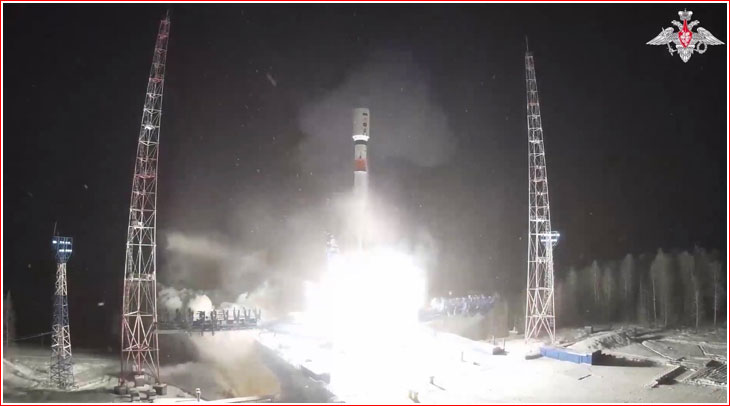
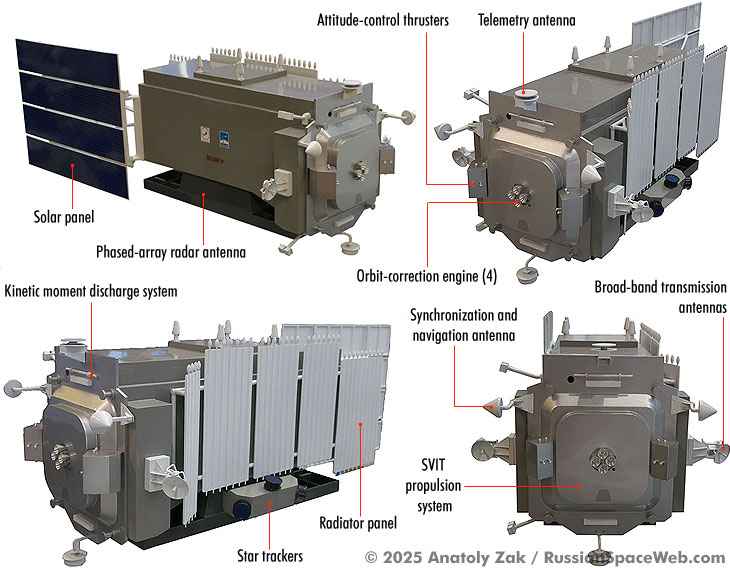
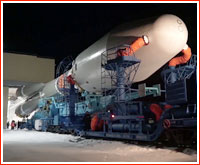
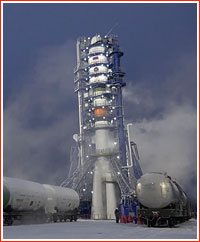
Soyuz launches first Obzor radar satellite A long-delayed all-weather imaging satellite went into orbit on a Soyuz rocket on Dec. 25, 2025, after a 24-hour delay. The Obzor-R project was initially developed by the Roskosmos State Corporation within its civilian program, but the launch campaign of the first spacecraft in a series from a military site in Plesetsk was mostly shrouded in secrecy under the usual format of a classified mission.
Obzor-R No. 1 mission at a glance:
Obzor-R1 development
The 10-year Russian Federal Space Program, FKP-2025, formulated in 2015, penciled the launch of the first Obzor-R satellite for 2019. However, by that time, Moscow-based RKS Corporation still struggled with the development of the main radar instrument for the spacecraft. Nevertheless, Roskosmos felt confident enough in the overall project to issue a procurement contract worth 1,326,420,150 rubles ($20.7 million) for a Soyuz-2-1a rocket intended to launch Obzor-R1. According to the document, the launch vehicle would have to be delivered on June 30, 2021. In May 2022, RKTs Progress said that the delivery of the Kasatka-R radar instrument for Obzor-R No. 1 was scheduled for the second quarter of 2022, but by August 2022, the shipment was moved to the third quarter of the same year. In August 2024, Head of RKTs Dmitry Baranov said that the development of Obzor-R No. 1 had entered the final stage and its launch had been scheduled for the fourth quarter of the same year. By that time, the dual-use Obzor-R was to join the Kondor-FKA, Meteor, as well as exclusively military Pion-NKS and, possibly, Neitron satellites, which believed to be using radar systems for all-weather, day-and-night imagery of the Earth's surface. Obzor-R1 launch campaign In early December 2025, Russian authorities issued air and sea advisories for impact sites matching drop zones of the second stage and the payload fairing of a Soyuz rocket heading to a near-polar orbit. The timing of the launch window opening daily from Dec. 11 to Dec. 16, 2025, suggested a target orbit whose plane closely aligned with the movement of the terminator (the border line between day and night). If launched as planned, the spacecraft would be crossing from the Southern to Northern Hemisphere (known as passing the ascending node) at around 18:00 local time below its flight path, and after swinging over the North Pole, it would cross the Equator back into the Southern Hemisphere (pass the descending node) at 06:00 local time in that region. If the spacecraft was able to maintain its orbital period (the time required to complete one orbit) at around 97.64 minutes, all other orbital parameters would remain mostly steady over a prolonged period of time. These orbital mechanics essentially excluded the possibility of an optical imaging payload to be launched during this mission, because it would have mostly nighttime conditions below its flight path, while providing constant sunlight for the spacecraft's solar panel. So a radar-carrying satellite, such as Obzor-R, emerged as the primary candidate for this classified launch. By Dec. 10, 2025, the launch advisories were canceled, indicating that that mission had been delayed once again, possibly, to inspect all the launch pads of the Soyuz rockets in the wake of the collapse of the mobile service platform at Site 31 in Baikonur on Nov. 27, 2025, during the Soyuz MS-27 launch. According to a poster on the Novosti Kosmonavtiki web forum, by that time, the payload for the mission was fully fueled and its launch vehicle was ready for the rollout to the pad, but it had to wait inside the assembly building for a "dry run" rehearsal at the pad in preparation for multiple launches of the Buro-1440 Internet constellation (INSIDER CONTENT), which were then expected to commence in 2026. According to the poster, the transporter-erector for the Soyuz rocket would become available for the Obzor-R1 mission by Dec. 17, 2025, paving the way for the rollout of the rocket to the launch pad. Sure enough, on Dec. 15, the launch advisory re-appeared, this time targeting windows extending from 17:00 to 18:00 Moscow Time daily between Dec. 23 and Dec. 28, 2025. The main launch attempt was then reportedly set for the evening hours local time in Plesetsk on Dec. 24, 2025, again confirming the launch into a near-terminator orbit. Obzor-R1 lifts off The launch attempt on Dec. 24, 2025, was never reported but a poster on the Novosti Kosmonavtiki web forum said that the liftoff had to be postponed for 24 hours due to strong winds. On Dec. 25, 2025, the mission apparently proceeded as scheduled, lifting off at 17:11 Moscow Time, according to the Ministry of Defense. In its announcement about the launch, the Russian military did not make a usual characterization of the payload as belonging to the Ministry of Defense, thus hinting the delivery of a non-military satellite. The Roskosmos statement issued several hours later also made no mention of the spacecraft type launched. Launch profile for the Obzor-R mission 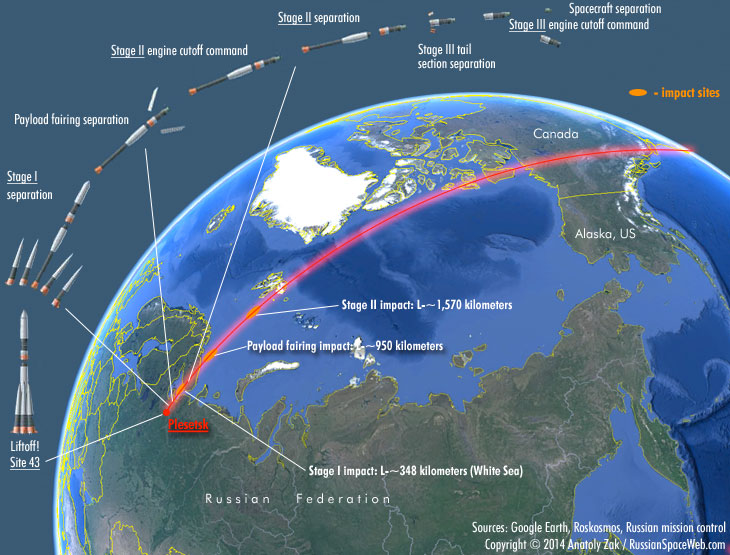
To deliver the Obzor-R1 satellite into a near-polar orbit, the Soyuz-2 rocket likely followed a typical ascent profile to reach an orbit with an inclination of around 97 degrees toward the Equator. After several seconds of vertical ascent, the vehicle turned north and dropped four boosters of the first stage around two minutes later with the impact expected in the White Sea of the Northern Coast of Russia, less than 350 kilometers from the launch site. Shortly thereafter, the rocket was safely beyond the dense atmosphere, allowing to split and drop two halves of the 81KS payload fairing, which then fell into the Barents Sea of the coast of Cola Peninsula, around 950 kilometers downrange from Plesetsk. The second (core) stage was to operate for another three minutes and after separating, it was expected to fall into the Arctic Ocean, off the coast of Svalbard Archipelago, some 1,570 kilometers from the launch site. The third stage was to fire for around five minutes, before releasing the spacecraft into a near-polar orbit less than nine minutes into the flight. The Obzor-R1 satellite was expected to use its own propulsion system to refine its trajectory parameters and enter an operational Sun-synchronous orbit. Within 24 hours after the launch, the US Space Force cataloged two objects associated with the launch of Obzor-R1:
Around three days after the launch, the Obzor-R1 maneuvered boosting its perigee, which put it into a 428 by 638-kilometer orbit. By the end of the first week of 2026, the satellite was tracked in its expected 645 by 641-kilometer near-circular orbit and it was rumored as starting delivering its first imaging data on Jan. 14, 2026.
|
|
|||||||||||||||||||||||||||||||||||||

|