|
|
    
|
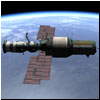
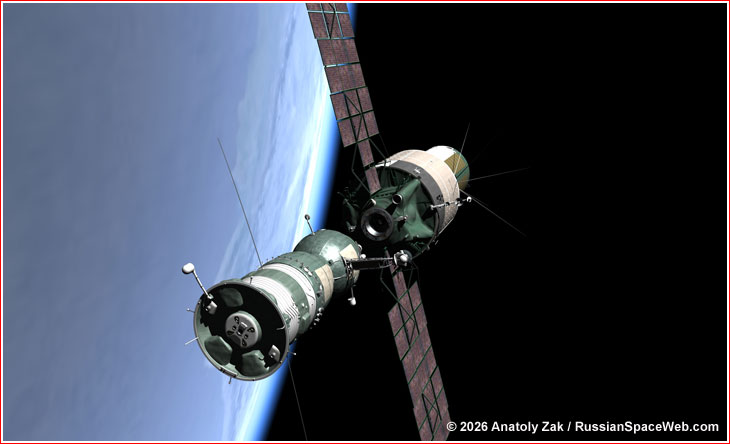
Soyuz-21 mission cut short by mysterious illness In July 1976, the beleaguered Almaz project got its second chance to demonstrate that a piloted vehicle in Earth's orbit could be used for effective strategic reconnaissance from space. Instead, the Soyuz-21 mission to Salyut-5 stumbled at almost every step and had to be terminated early under rather strange circumstances.
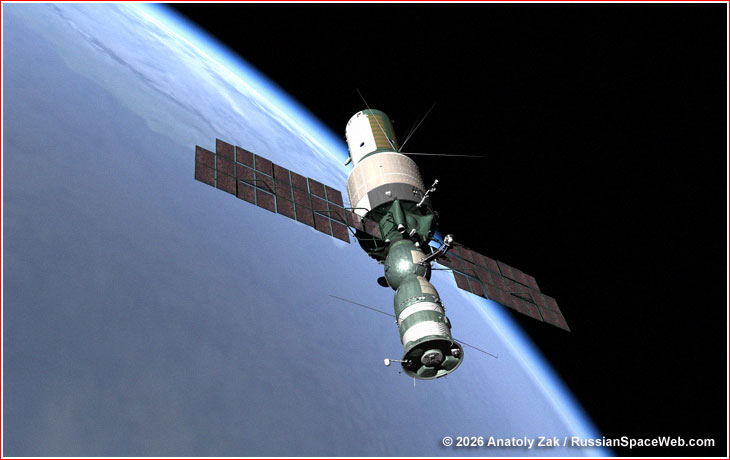
Soyuz-21 mission at a glance:
Launch at the brink After the announcement of the successful launch of the Salyut-5 space station on June 22, 1976, there was a week of silence in the Soviet press, but, of course, behind the scene, hectic work was continuing on the preparations for the launch of the first expedition to the station. It was scheduled to stay aboard OPS-3 for 60 days. As usual for the Almaz project, the mission was primarily dedicated to military reconnaissance, but the cosmonauts' objectives also included a great deal of scientific studies. The liftoff of the Soyuz-21 spacecraft was scheduled for July 6, 1976, from Site 1 in Tyuratam and most history books mention it as uneventful. However, one veteran of that campaign revealed a mad drama playing out at the launch site, which was only published at the end of 2010s. E.A. Zaitsev, specialist in orbital mechanics in the Almaz project was sent to represent TsKBM at the Soyuz launch, which was managed by the rival firm NPO Energia. According to Zaitsev, who was in one of the auxiliary buildings at Site 1 on the launch day, he heard an unusual announcement over the loudspeakers: "Down goes product 02. Careful." This was a code warning for an accidental spill of hydrogen peroxide, which was used in the propulsion system of the launch vehicle. Zaitsev remembered that it was four hours before launch, while the rocket was being fueled and the crew was already in the spacecraft. 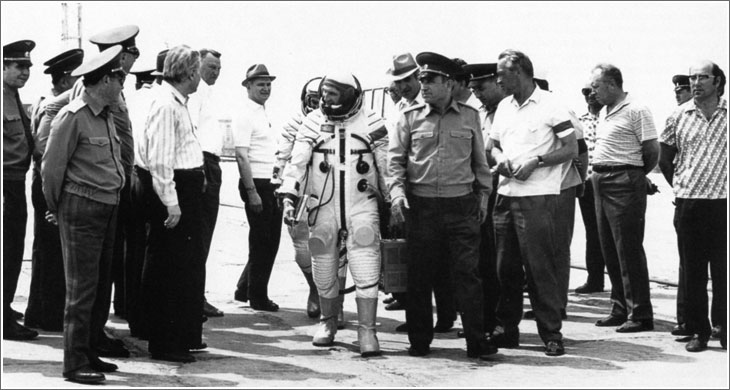
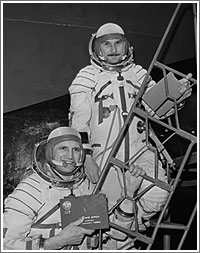
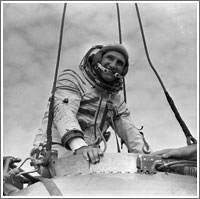
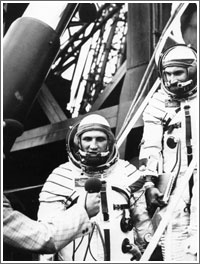
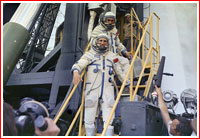
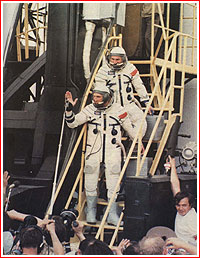
Volynov (front) and Zholobov walk to their spacecraft on July 6, 1976. Valentin Glushko, the chief design of NPO Energia (in light civilian hat and Minister Sergei Afanasiev can be seen on the background left of the cosmonauts. In any case, the pad personnel then discovered that the fueling tank on the pad did not have enough peroxide to replenish the rocket. In response, the officials from the State Commission, who gathered in the firing bunker near the launch pad, banned all (outgoing) phone calls from the facility, apparently in an effort to prevent the news about such an embarrassment from leaking to higher echelons of the government. Simultaneously, they ordered a locomotive to drive a tank to the propellant storage (possibly at Site 3) for another load of peroxide delivery. In the meantime, Zaitsev was approached by his colleagues from TsKBM, Viktor Polyachenko and A.G. Zhamaletdinov, who just emerged from the firing bunker and "whispered" to him a question whether it would be possible to postpone the launch for one or two days. Zaitsev estimated that in order to support a rendezvous with Almaz at an (operational) orbit with an altitude of 275 kilometers the next day, the station would have to be immediately maneuvered down to a 205-kilometer orbit (to provide necessary phasing of the orbit) and then boosted back to 275 kilometers, which would consume an amount of propellant worth 41 meters per second in velocity change (Delta V). A rendezvous in two days would "cost" 20.5 meters per second in Delta V, but it would violate the criteria for keeping the fueled rocket on the launch pad under conditions of 30-degree heat. Most importantly, in both cases, the propellant expenditure aboard Almaz would be so great that it would preclude future expeditions to the station. To drive the point home about the gravity of the situation, while avoiding being the bearer of bad news, Zaitsev sent his estimates not to the State Commission in the nearby bunker but to Yu. Klimov, the head of the coordinating group at the Chief Ballistic Center in Moscow "for confirmation." Sure enough, Klimov responded with a memo to the commission entitled "On the actions in non-nominal situations after the transport vehicle launch delay." The document confirmed Zaitsev's estimates and provided necessary data for orbit corrections. When coming from a much higher level, the State Commission ruled out the delay and pressed with final preparations. (It is unclear why until the last minute, officials at that level did not have the most basic info on back-up launch opportunities.) However, the launch campaign then hit another bizarre obstacle in the form of a heavy KrAZ truck which stalled on the railroad crossing, blocking the way for a locomotive with a hydrogen peroxide tank on its way to the storage site. At the same time, with all the phone calls from the facility blocked, officers in charge had a few opportunities to intervene. As Zaitsev remembered, in the brutal summer heat of Tyuratam, passions were running high. To top it off, the State Commission did get an incoming phone call in the bunker from... the head of Soviet KGB Yuri Andropov, supposedly inquiring whether the problem could be resolved. Why the KGB boss was micro-managing a launch and how he got a word about the situation with all the communications cut off was anybody's guess. In the end, the range personnel manually pushed the lorry off the tracks and the locomotive with the tank proceeded at full speed to the storage site and back to the pad. It was in time to refill the rocket for a instantaneous launch window providing a rendezvous with the Almaz (Salyut-5). Soyuz-21 lifts off 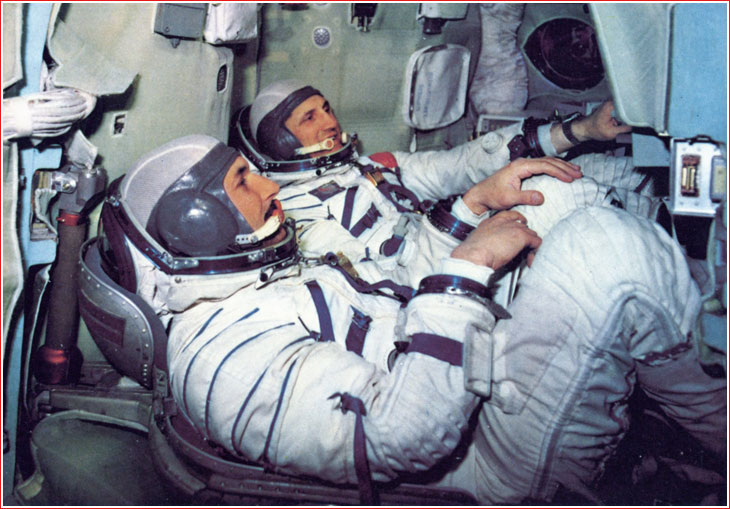
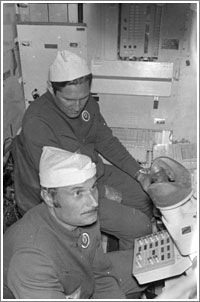
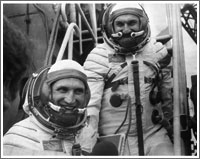
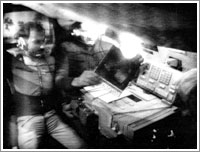
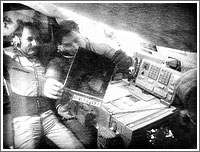
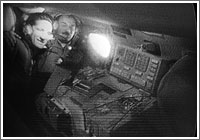
Zholobov (foreground) and Volynov inside the Descent Module of the Soyuz spacecraft. The first expedition to the Salyut-5 space station lifted off from Site 1 in Tyuratam on July 6, 1976, at 15:08:45 Moscow Time. The typical Soyuz launch to Almaz included a vertical ascent of the rocket for eight seconds, followed by a north-east pitch maneuver to align its trajectory with an orbit inclined 51.6 degrees toward the Equator. The spent four boosters of the first stage would be dropped just short of two minutes into the flight (L+118.00 seconds), followed by the separation of the Emergency Escape Rocket tower at L+157.00 seconds). The payload fairing, protecting the Soyuz from aerodynamic loads would be split into two sections and separated at L+161.00 seconds. The second stage would continue firing and separate at L+288.00 seconds, followed by the separation of three segments of the aft sections on the third stage at L+308.00 seconds. The third stage would ignite moments before the separation of the second stage and initially fire through a truss section connecting the two boosters and separating with the second stage. The third stage would continue firing until reaching orbit and separate at L+530.00 seconds into the flight. Seven seconds later, the Soyuz would deploy its antennas of the Zarya communications system and the Igla rendezvous system. After reaching orbit, the mission was announced as Soyuz-21. After the fact, the Soviet TV also showed a recorded "broadcast" of final preparations and launch. Aboard the spacecraft were a veteran of the original Vostok cosmonaut group Boris Volynov, serving as a commander, and a rookie Flight Engineer Vitaly Zholobov. For communications with ground control, the crew used the call sign "Baikal" after a lake in the Soviet Far East. Both cosmonauts were known to be backups to the primary crews heading to the Salyut-3 station and both were members of the military, which distinguished them from crew composition operating Salyut-4, which normally had a civilian flight engineer. It was another confirmation for the watchers of the Soviet space program that a military outpost was now in orbit. The timing of the launch in the middle of the day also indicated that the ideal time for landing in daylight hours at the primary landing area in Kazakhstan would be between Sept. 3 and 12, 1976, or after 59-68 days in orbit. That was an argument (as later transpired a correct one) against the previously rumored three-month expedition, which was in-fact considered but ultimately rejected. (50) The timing of the launch also put the Soyuz vehicle on a 24-hour rendezvous path to the station. After entering the initial 193 by 253-kilometer orbit, the ship maneuvered to a 254 by 280-kilometer orbit. As it transpired later, despite all the upgrades, once again, the automated Igla rendezvous system aboard Soyuz developed a problem during the final phase of the rendezvous; however this time, the crew vehicle successfully docked with the lab under manual control on July 7, 1976, around 13:40 GMT (16:40 Moscow Time). After a series of checks, Volynov and Zholobov opened the hatch and transferred inside Salyut-5, while out of communications with ground control. First expedition works on Salyut-5 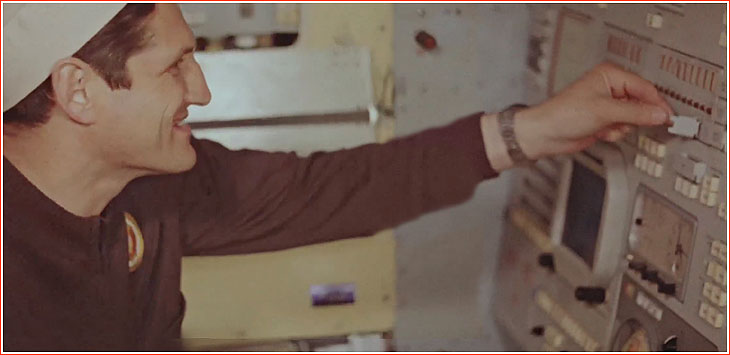
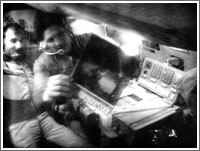
Volynov at the controls of the Almaz lab. With the Salyut-5 fully activated, the crew set about to fulfilling its flight program, which was described as more loaded than the previous mission of their colleagues aboard Salyut-4. In some contrast to the secretive expedition on Salyut-3, the Soviet sources published a rather long list of experiments planned aboard Salyut-5 during its presumed multiple expeditions. Needless to say, such an intensive "civilian" program was piled on top of a far more significant and top-secret military observation tasks. As the expedition progressed, the Soviet press provided rather regular updates on the mission, but the coverage was still noticeably scarce and colorless in comparison to the details and imagery that was available from the Salyut-4 mission. For example, TV broadcasts from Salyut-5, while appearing on Soviet TV, were seemingly designed to avoid showing any discernable interior features of the station. Certainly, no external or interior equipment was shown, let alone the architecture of the station itself. (50) Behind the scene, Volynov and Zholobov completed a multitude of military and civilian tasks during their first 40 days in orbit. Most importantly, the crew conducted numerous photographic sessions over the Soviet and foreign territories using the Agat camera and conducted 18 downlinks of imagery back to Earth via the Pechora transmission system, in some cases with a delivery time of 1.5 hours after the film exposure. A total of 231 experiments were reported to be conducted in different fields:
During the expedition, the general headquarters of the Ministry of Defense provided TsKBM with a flight assignment which was designed to be programmed into the station's onboard computer and included an orbit number, a route number and the time for beginning and completing each imaging session. The program was first tested on the computer's of the Almaz ground prototype and then transmitted to the control center in Yevpatoria, Crimea, for uplink into the Argon-16 computer aboard Almaz. Overall, the work was taking considerably longer than planned, often prompting the cosmonauts to resort to using personal time in an effort to catch up. They were also increasing cutting on their sleep, which was further exacerbated by frequent activation of alarms in the cabin. Power outage In the midst of the first expedition on Almaz, the work was suddenly interrupted by a massive power failure, leaving the crew without communications with ground control. The exact date of the accident is unclear, but Volynov's recollections contextually put it around mid-August 1976. According to Volynov, the sirens sounded when the station was on the night side of the Earth, all lights went out and the cosmonauts found themselves in complete darkness. They quickly realized that everything was off, including the air re-generation unit, which meant that they only had the current supply inside the station (not counting autonomous capabilities of the Soyuz). Their first order of business was to turn off the alarm, which they had to do by finding the right switch on the darkened console. Volynov remembered that once they turned the alarm off, it was the first time that they were in pitch black darkness and absolute silence, which was an experience not for "faint of heart" as he put it. They still managed to transmit a coded signal to the ground about an onboard emergency. However, it was a one-way communication and they still had no idea what had happened. Volynov remembered that initially he could not exclude depressurization, but, step-by-step, they were able to fully revive the station. (231) Mysterious illness? According to Volynov, the stress of the power outage, compounded by overwork and by the disrupted sleep pattern, led to the next crisis aboard OPS-3, this time with the cosmonauts themselves, which apparently developed "several days" after the power outage. On Aug. 19, 1976, Volynov first reported to mission control that Zholobov had complained about a severe headache and physicians on the ground had to issue recommendations on how to combat it. For two days everything looked fine, but on August 22, Volynov radioed that the condition of his Flight Engineer had worsened and in addition to the headache, Zholobov reportedly suffered from nausea and vomiting. No meds helped either, even though, they used up "everything they had in their onboard medical kit," as Volynov later remembered. Zholobov eventually stopped running on the treadmill, as was required by health guidelines, and mostly quit working, instead periodically floating around the station aimlessly "in a relaxed state," Volynov recalled. It also meant that the commander's workload had doubled. (231) In a radio exchange with mission control on August 23, Volynov said that Zholobov had only briefly appeared in the working compartment and was spending much of the time in bed. The situation puzzled the physicians on the ground because all medical data from both cosmonauts was normal, including the results of a specially arranged cardiac test for Zholobov. To further complicate the situation, Volynov reported a bad smell aboard the station, but no source of it could be found, even though it was apparently first experienced as early as August 6. Zholobov apparently suspected the presence of toxic chemicals in the station's atmosphere, possibly caused by a leak of hypergolic propellant components into the pressurized compartments. Even though Almaz engineers excluded such a possibility, Zholobov reportedly insisted on his "hypothesis" in a conference with ground control via an encrypted communications channel on August 23. After this communications sessions and the subsequent council between the head of the State Commission Mikhail Grigoriev, Head of the Military Industrial Commission Leonid Smirnov and Minister of General Machine-building Sergei Afanasiev, the officials made a decision to evacuate the station. Volynov's colleague from the first cosmonaut team Gherman Titov announced the decision to the crew. (1050) The flight managers instructed the cosmonauts to prepare for an emergency landing the next day, which meant that the appropriate pass of the spacecraft over the primary landing site would fall in the night time period. Despite such a short notice, Volynov still managed to properly mothball the station, as well as to transfer documentation, exposed film and even souvenir covers marked "Space Post Office Salyut-5" into the crew vehicle. Volynov also took samples of air, condensate and dust inside the station. Finally, the commander "packed" the semi-disabled Zholobov into his space suit and strapped him into his seat inside Soyuz, after which he took the middle seat in the Descent Module. Troubled undocking
Soyuz-21 was now set to depart the outpost on Aug. 24, 1976, or 11 days ahead of its planned return to Earth, however, the first attempt to undock from the station failed. According to Volynov, the attitude control thrusters on the Soyuz performed their planned 10-second separation burn prematurely, while the ship still remained firmly tied to the station, held by the hooks of the docking mechanism. Volynov asked Zholobov (who sat by the window) to check whether he could see a relative motion of the two spacecraft, but he replied that "No, we are standing still." Volynov reported the situation to the ground and was instructed to bring all systems aboard Soyuz into a default position. (231) A veteran of TsKBM V. Sachkov, who obviously had good reasons to be frustrated with the crew, later recalled that the cosmonauts had panicked, triggering a major alarm in mission control and at TsKBM. The bureau's specialists immediately rushed to the ground prototype of the station trying to reconstruct the problem. Within minutes after the incident, the head of the laboratory Vladimir Itkin conducted a successful undocking simulation, which was used to compile a new set of instructions for the operation of the docking mechanism to be radioed to the crew. The undocking was ultimately conducted successfully during a subsequent orbit, around 15:12 GMT (18:12 Moscow Time) on Aug. 24, 1976, under remote commands from the ground. (1050) However, the spacecraft was now heading to one of the back-up sites, which was still in Kazakhstan, but required some extra time to shift search and rescue teams there. Soyuz-21 returns to Earth 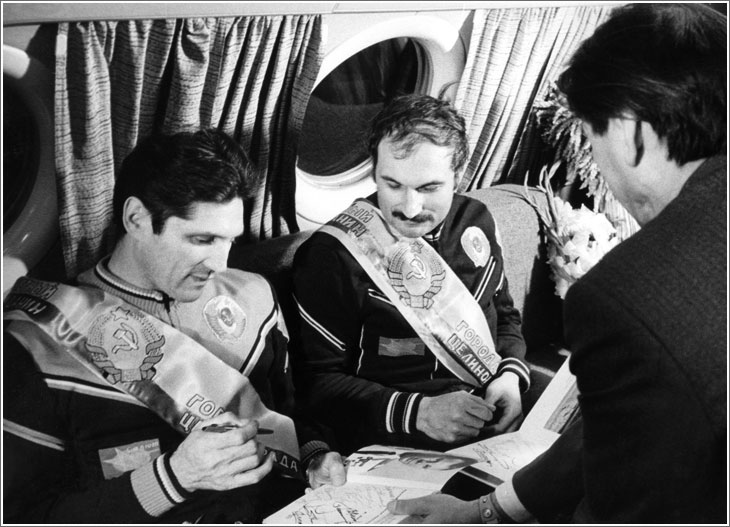
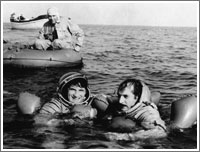
Volynov (left) and Zholobov sign autographs aboard the plane from Tselinograd to Tyuratam, after the successful landing of Soyuz-21. The reentry and the descent of Soyuz-21 went normally, but at the touchdown in night-time conditions (18:33 GMT, 21:33 Moscow Time 23:33 local) on Aug. 24, 1976, the capsule made two bounces and slid a few meters on its side, leaving the cosmonauts hanging on their safety belts from the "ceiling." Fortunately, the crew members were able to get out of their craft independently Volynov got out first and then extracted Zholobov, who had his helmet jammed. Volynov's first attempt to open it resulted in an electric short circuit accompanied by sparks. Fortunately, the second attempt worked. Around 40 minutes after touchdown, rescue personnel finally arrived at the site, which turned out to be 200 kilometers southwest of Kokchetav in Kazakhstan. (231) On August 25, the crew made it back to Tyuratam and the next day, Soviet newspapers came out with the usual fanfare, including a letter from the cosmonauts to the Secretary General of the Communist Party Leonid Brezhnev, reporting that "all the tasks assigned to the crew had been completed, the landing of the Soyuz-21 spacecraft was conducted successfully in the planned area. The Salyut-5 orbital station and all its systems worked normally and showed high reliability." (1050) However, careful watchers of the Soviet space program could immediately see through the usual smoke-and-mirrors of the official press. The sudden public announcement on August 24 about the impending landing of Soyuz-21 was very surprising not only because the return came far sooner than expected, but also due to an unusually short notice in comparison to previous Salyut expeditions:
This time, the Soviet press broke the news at 10:04 GMT (13:04 Moscow Time) and the landing itself took place within just 12 hours on August 24. Obviously, wild rumors were swirling around among the space enthusiasts about the kind of emergency that could force a premature landing and led to the renewed questions whether the planned mission was to last 60 or 90 days. The suspicions that the expedition had to be returned due to the effects of "sensory deprivation" on the crew had floated right away, followed by a report in the US-based Aviation Week & Space Technology magazine that the crew had to do an emergency landing because of an acrid odor in the station's atmosphere. (50)
|
|
 |