|
|
|
    
|
||||||||||||||||||||||||||||||||||||||||||||||||||||||||||||||||||||||||||||||||||||||||||||||||||||||||||||||||||||||||||||||||||||||||||||||||||||||||||||
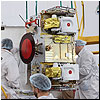
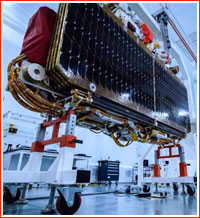
The second batch of "Russian Starlink" satellites launches Multiple spacecraft developed at Moscow-based Buro 1440 (INSIDER CONTENT) rode into orbit on a Soyuz-2 rocket from the Plesetsk launch site. It was presumed to be a 16-satellite cluster of near-operational Rassvet satellites (INSIDER CONTENT), following their first mission on March 23.
Second Buro 1440 batch launch at a glance:
At the time of the first Rassvet launch, the second mission was rumored to be targeted for as early as April 2026. The navigational warnings for air and sea traffic, matching the March 2026 mission, appeared around July 10, 2026. As before, the navigation warnings declared unusually long (24-hour) windows, likely designed to complicate the prediction of the exact launch time and the fueling period during the launch campaign to minimize threat from Ukrainian air strikes. Likely for the same purpose, the Russian government issued multiple other warnings with partially overlapping time windows in July 2026, which could be associated with as many as four different launches. According to Bart Hendrickx, they matched ascent trajectories for Soyuz rockets to orbits inclined 63, 82 and 97-98 degrees, as well as a suborbital launch of the Yars ICBM. The second Rassvet launch was expected to bring the total number of operational satellites in orbit to 31, taking into account one spacecraft from the first batch that had since reentered. On July 20, 2026, Buro 1440 issued a statement on the Russian-banned Telegram web site about the successful launch of its second spacecraft batch. According to the announcement, the satellites successfully separated from the launch vehicle and established communications with the company's mission control. "After completion of checks and the operational activation of sub-systems, the satellites will begin transfer to a target orbit for providing communications services," the announcement said. It did not contain the launch time or the official designations of the satellites. Roskosmos and the Ministry of Defense have not made any announcements of the launch either, as of July 21, 2026. According to space analyst Robert Christy, based on the pass of the satellites observed by a Subaru telescope in Hawaii on July 20, 2026, the launch took place around 17:51 UTC (20:51 Moscow Time) on July 19. Launch scenario
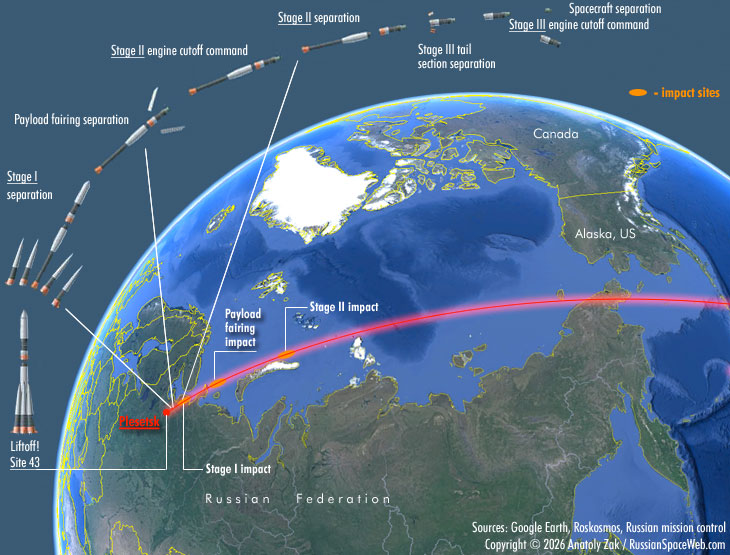
To deliver Rassvet satellites from Plesetsk, a Soyuz-2 rocket turns northeast seconds after a vertical liftoff and then heads roughly along the ascent corridor previously used to deliver Kobalt-M satellites. Around two minutes into the flight, the vehicle drops the four boosters of the first stage, which are projected to impact the ground near the town of Koida in the Menzensk District of the Arkhangelsk Region, on the shore of the Barents Sea. Seconds later, it is followed by the separation of the payload fairing, whose two sections fall in the Barents Sea, off the coast of Kanin Peninsula. Around five minutes into the flight, the second stage completes its work and separates on a ballistic trajectory impacting the Arctic Ocean, north of the Novaya Zemlya archipelago. The third stage completes the orbital insertion of the 16-satellite cluster around 8.5 minutes after the liftoff, likely releasing the satellites into a near-polar circular orbit with an inclination around 83 degrees toward the Equator. The satellites are expected to separate from the upper stage in short intervals and use their own propulsion systems to evenly spread along the orbital plane intended for the constellation. Second Rassvet cluster begins orbital climb No official updates on the fate of the satellites was issued by Roskosmos, the Russian military or Buro 1440 in the five days after launch, but on July 24, 2026, the US Space Force catalogued the expected 17 objects (16 satellites and the upper stage) in an average 290 by 327-kilometer orbit with an inclination 82.3 degrees toward the Equator:
The group's Right Ascension of the Ascending Node, RAAN, (a point where the satellite's ground track crosses the Equator on its way from the Southern to the Northern Hemisphere) was 226.8 degrees, meaning that the orbital plane of the whole group was more than 100 degrees away from that of the previous 16 Rassvet satellites launched in March 2026 into an orbit with a RAAN ranging from 330 to 338 degrees. Between the end of July and early August 2026, nine satellites in the second group had initiated orbit-raising maneuvers, which exceeded the decay rate of their orbits, but their resulting altitudes varied from 313 to 332 kilometers at that point, which was around 200 kilometers lower than the altitudes of the first group during the same period. Those nine active satellites in the second group appeared to begin maneuvering sooner after their launch than the satellites in the first group. The rest of the spacecraft in the second group were either losing altitude without maneuvers or their maneuvers were not significant enough to counteract the decay caused by the air friction in the upper atmosphere. By Aug. 5, 2026, 11 satellites in the second group were noticeably climbing, but by the end of August, three more satellites appear to abondon attempts to climb and their orbit began to decay slowly at altitudes ranging from 310 to 330 kilometers. At the same time, a pair that had never maneuvered fell below 300 kilometers and appeared to be heading for reentry. Overall, none of the satellites within the group managed to climb above 360 kilometers.
|
|
|||||||||||||||||||||||||||||||||||||||||||||||||||||||||||||||||||||||||||||||||||||||||||||||||||||||||||||||||||||||||||||||||||||||||||||||||||||||||||

|