|
|
|
    
|
|
||||||||||||||||||||||||||||||||||||||||||||||||||||||||||||||||||||||||||||||||||||||||||||||||||||||||||||||||||||||||||||||||||||||||||||||||||||||||||||||||||||||||||||||||||||||
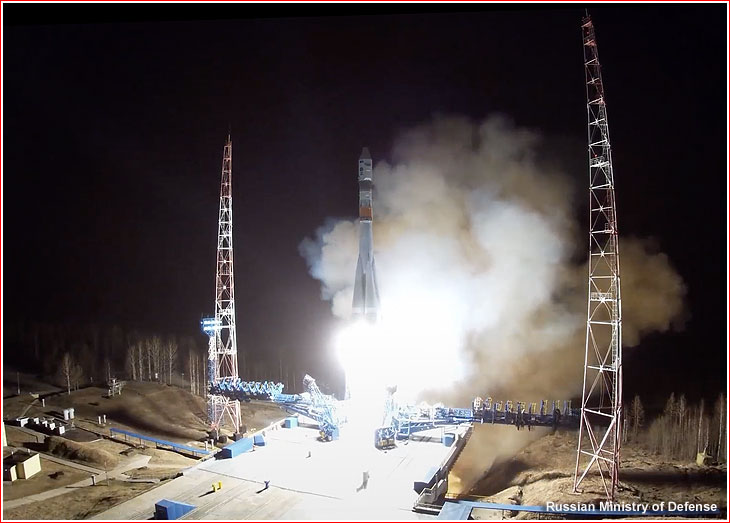
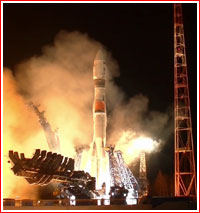
Soyuz rocket launches a military payload In the early hours of April 17, 2026, a Soyuz-2-1b rocket lifted off from the Plesetsk military launch site with a classified cargo for the Ministry of Defense.
Soyuz rocket launch on April 17, 2026, at a glance:
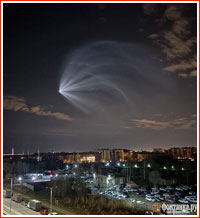
Around April 10, 2026, Russian authorities issued multiple warnings to air and sea traffic about upcoming rocket launches: one on April 13 and one on April 29, with launch windows between 21:00 and 23:59 UTC, and another between April 14 and April 30, with an unusually long window between 00:00 and 16:00. As noted by a space historian Bart Hendrickx, the announced danger zones matched known impact sites for the payload fairing of the Angara-1.2 rocket and for the second stage of the Soyuz-2 rocket, either indicating parallel launch campaigns for two vehicles based in Plesetsk or intentionally creating confusion as a countermeasure against a potential attempt by Ukrainian forces to strike a fueled rocket on the launch pad. According to the statement by the Russian Ministry of Defense distributed by the official Russian media around 03:00 Moscow Time on April 17, 2026, the Soyuz-2-1b rocket lifted off as planned with multiple spacecraft for the Ministry of Defense. Soon after 02:30 Moscow Time, multiple sightings of what appeared like a rocket ascent was reported in Finland. Around 09:30 Moscow Time, the Ministry of Defense reported that the launch at 02:17 Moscow Time was a success and the spacecraft were successfully delivered into their orbits. The published visuals of the launch revealed a Soyuz rocket with a payload fairing typically used in a combination with the Volga upper stage, however no warning had ever been issued for any area of the ocean normally used for deorbiting a space tug. 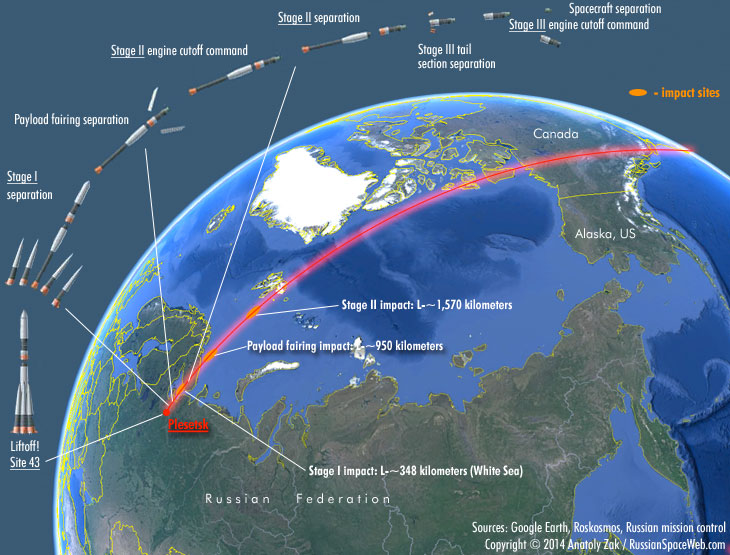 The expected ground track of the ascent trajectory for Soyuz rocket during launch in April 2026. The US Space Force initially catalogued a single object associated with the launch in a 457 by 547-kilometer orbir with an inclination 98.33 degrees toward the Equator. A few hours later a total of three objects were tracked:
Several hours later, on April 17, 2026, five objects were catalogued and two NORAD ID numbers were skipped, when the US Space Force registered the following Chinese launch on the same day, indicating that more objects from the Russian launch may have been tracked but not yet listed:
It appeared that Object C represented the third stage of the Soyuz-2 rocket, because it remained in an elliptical orbit with a low perigee, after which Object D (likely representing the Volga upper stage) performed circularization of the orbit and then released its payloads: Objects E, A and B. The apparent inclination-change maneuver by Object D from initial 98.26 degrees to 96.95 degrees remained unexplained. Possibly, that maneuver was costly enough to leave the space tug without enough propellant to make a deorbiting maneuver previously performed in all but one mission of the Volga stage. By April 18, 2026, the US Space Force published tracking data for a total of 10 objects associated with the April 17 launch. The latest objects (F, G, H, J and K) were tracked in a 550-kilometer near-circular orbit with an inclination 96.95 degrees, indicating that they were released from the upper stage after it had completed the inclination-change maneuver. By that time, Object D was tracked in a 463 by 481-kilometer orbit indicating an orbit-lowering maneuver likely designed to accelerate the atmospheric reentry of the spent booster:
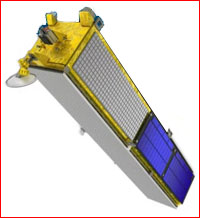
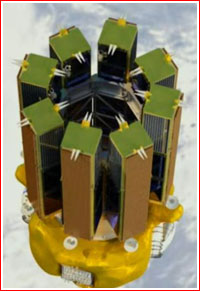
One possible candidate for the eight-satellite payload launched on April 17, 2026, were the Diamond-X radar-imaging satellites, which were advertised around 2023 by the NPO Mashinostroenia enterprise based in Reutov near Moscow. The quintet of satellites with a mass of 350-400 kilograms each was expected to be delivered into a 500-550-kilometer Sun-synchronous orbit by a Soyuz/Fregat launcher. At the time, the company described the Diamond-X project as a self-funded proposal, which completed the initial paper design phase known as NIR (from the Russian Nauchno-Issledovatelskaya Rabota), but it is not impossible that the Kremlin's ballooning military budget could pick up the tab since then. NPO Mashinostroenia was involved in the development of radar-imaging spacecraft since the dawn of space era and recently completed the development of the Kondor-FKA satellites for Roskosmos, and, possibly, its classified version for the Ministry of Defense. Between April 28 and 29, 2026, at least five satellites within the newly launched group manuevered by as much as two kilometers relative to their original altitude, according to tracking data from the US Space Force. Two satellites raised their orbits, while three others decreased their altitude. Six payloads are identified in the April 17, 2026, launch By May 2, 2026, the US Space Force, identified only six objects from the April 17, 2026, launch as satellites, while the two other objects were determined to be fragments from the Soyuz' third stage:
As noted by Bart Hendrickx, if Object C (68755) was indeed a fragment of the third stage from a Soyuz rocket, it likely separated from it during its active burn (because it was tracked in an orbit that was considerably lower than the orbit where the Soyuz booster ultimately ended up, according to the US Space Force). Object E, on another hand, was just around a dozen kilometers below the stage, so it likely separated at the end of the engine burn or was given some push downwards soon after the booster's shutdown. The intentional ejections of operational payloads during active maneuvers are extremely rare, so the observable situation could have been a result of an anomaly or, less likely, a planned jettisoning of some components, such as sensor covers. Finally, there was also a chance of mis-identification of objects. On May 22, 2026, Integrity ISR publication said that the four of six satellites in the group performed unusual inclination-change maneuvers worth between 105 and 106 meters per second in velocity change, which put them into a co-planar orbit with the IcEye-X36 radar-imaging satellite (NORAD ID 59103) of the US-Finnish company IcEye, which is known to provide imagery for Ukraine. According to Integrity ISR, the satellites, presumed to be named Kosmos-2610, -2611, -2612 and -2613, changed their inclination from 97.0 to 97.8 degrees toward the Equator between May 14 and May 20, 2026, while further tracking data indicated that Kosmos-2614 had been in process of similar maneuvers, the publication said. It also noted that the Russian satellites were originally launched into an orbit with the Right Ascension of the Ascending Node, RAAN, (the point where the satellite crosses the Equator from the Southern to the Northern Hemisphere), just 0.5 degrees from IcEye-X36's RAAN, which combined with the matching inclination, would enable them to fly from 0.5 to 22 kilometers from IcEye-X36, Integrity ISR said. Experimental Okulus revealed as a payload On June 6, 2026, the AK Novy Kosmos startup announced that its first satellite (INSIDER CONTENT) was launched in April 2026. At the time of the announcement, "the spacecraft was undergoing flight tests and trials of techniques required for the development of company's products in the field of radar imaging," Dmitry Matsuk, the Chairman of Board of Directors at Novy Kosmos was quoted as saying.  |
|
||||||||||||||||||||||||||||||||||||||||||||||||||||||||||||||||||||||||||||||||||||||||||||||||||||||||||||||||||||||||||||||||||||||||||||||||||||||||||||||||||||||||||||||||||||||

|